Saturday, 4 February 2023

Modern Psychic Mysteries and Sir Arthur Conan Doyle’s resignation from the Society for Psychical Research


1 Events at Millesimo Castle

Modern Psychic Mysteries, by Gwendolyn Kelley Hack, is a lengthy record of a series of séances which took place in Italy in 1927-8.  These were arranged by Marquis Carlo Centurione Scotto, resident at the mediaeval Millesimo Castle near Savona in northern Italy.  A medium himself, he participated in the séances in the hope of contacting his son, the Marquis Vittorio dei Principi Centurione, who had died in September 1926 while testing an aeroplane for a Schneider Cup race.  Having read an Italian translation of H Dennis Bradley’s 1924 book Towards the Stars (Verso la Stelle), he had attended séances with American medium George Valiantine at Bradley’s home in Surrey, where he received what he considered strong evidence of Vittorio’s survival.

Valiantine gave the Marquis an aluminium trumpet, suggesting he attempt direct voice mediumship at home.  This he did, and the resulting séances, with himself and Signora Fabienne Rossi acting as mediums, were extremely successful.  Modern Psychic Mysteries (1929) is a compilation of séance reports and commentary assembled by Mrs Hack, one of the sitters and herself a mental medium as well as an artist.

Hack relied heavily on others’ accounts, notably those of Professor Ernesto Bozzano, who also contributed a lengthy preface.  His favourable reports on the sittings had already appeared in the Italian periodical Luce e Ombra.  The structure of the book is chaotic and often prolix and repetitive, but cumulatively it provides a fascinating account, one that was to have far-reaching ramifications beyond the Italian borders.

An extensive range of phenomena was said to have occurred in the dark: the materialisation of hands and feet; the levitation of the Marquis to a height of six feet while sitting in a heavy chair; apports (bulky items that could not easily be concealed within the room) and asports; antique weapons engaging in a noisy battle; the movement of sometimes weighty and bulky objects; direct writing; the movement of a heavy table; thuds and bangs; the playing of musical instruments as they floated.  On one occasion the sitters were creating a favourable atmosphere by singing a fascist song when an illuminated picture of Mussolini was transported from an adjoining room through closed doors.  Curiously, although it arrived intact, a direct-voice trumpet fell on it, breaking the glass.  Perhaps someone present was not a fan of Il Duce.

A flexatone (a ‘musical’ instrument only recently patented) moved through the air while accompanying music playing on the gramophone.  The trumpet flew around, the voices emanating from it speaking a range of languages: Latin, Spanish, German plus five Italian dialects, in one of which a discarnate Eusapia Palladino (died 1918) communicated.  During a session in July, the Marquis suffered terribly from the heat, and when this problem was raised by the sitters a refreshing blast of icy air swept through the room.

An entity identifying itself as Cristo d'Angelo, claiming to have been a Sicilian shepherd, acted as control.  He possessed a range of abilities, such as reading the thoughts of people both during séances and on other occasions, answering questions put mentally, reading messages in sealed envelopes, providing a remote medical diagnosis of leukaemia, plus indicating a cure, making a prediction of death (somewhat dubious ethically), and saying what was happening to circle members when they were elsewhere.

Most famously, on 29 July 1928 the Marquis was transported, or asported, from the locked séance room, necessitating a two-and-a-half-hour search of the castle and grounds.  He was eventually found after Mrs Hack received an automatic message through her spirit guide Imperator supplying his location: he was fast asleep on a pile of hay and oats in a granary within the stables, the door locked from the outside.

Unfortunately, quite often information was withheld by Hack on account of its private nature.  This secrecy was of importance to those concerned but unhelpful to the independent observer, who was prevented from assessing it.  However, enough is presented to establish the phenomena as wide-ranging and dramatic.  Hack was clearly convinced by them, yet it is noticeable from the transcripts that despite the phenomena supporting a paranormal explanation, there were many instances where direct questions were deflected, or evasive answers provided, when there was no reason not to provide the information requested.

Hack conceded that controls had been poor but, working on the assumption she would have been able to detect fraud if it occurred, defended the results on the grounds of the Marquis’s class and amateur private status as a medium, and the impossibility of carrying out the phenomena by fraudulent means in the dark.  She argued that ‘it is possible to conduct a whole series of metapsychic experiments which give solid, scientific proof, without adopting any kind of personal control of the mediums whatsoever.’  It is hardly surprising her critics disagreed.

However, while some may have thought the Marquis had nothing to gain by cheating, not everybody was convinced the séances provided reliable evidence.  Critics included Baron Albert von Schrenck-Notzing, Rudolf Lambert – and Theodore Besterman, whose blistering review of Hack’s book in the SPR’s Journal (of which he was the editor) caused veteran member Sir Arthur Conan Doyle to leave the SPR in high dudgeon.


2 Theodore Besterman reviews the book

Besterman dismisses Modern Psychic Mysteries as displaying ‘an almost complete lack of understanding of what constitutes good evidence and adequate recording of mediumistic sittings.’  For those readers who find the 360 pages of Hack’s volume a slog, it is heartening to find Besterman in agreement.  He states that ‘In the present review I take into account only Signor Bozzano's reports. The remainder of the book (with the exception of a few pages by Professor Castellani) is too confused and ill-arranged to be seriously considered, apart from being disfigured by scores of misprints and literal mistakes.’

He notes the lack of controls, with sitters drawn from family and friends in the Marquis’s own home, poor documentation of the séance room and progress of the sessions, doors and windows that would make it hard to secure the environment, and the frequent playing of the gramophone which could cover fraudulent activity.  Bozzano’s claim that the trumpet whirled about with precision is undermined by references to sitters being knocked on the head, and air currents can be generated by the use of balloons.  Besterman wonders how the flexatone was introduced to the circle as Bozzano says no one had heard of it before (it would perhaps be more accurate to say they claimed they had not) and it was difficult to play.

Besterman grumpily thinks that as no information is available on the instrument, and Bozzano fails to describe it adequately, what he has to say about it is hard to evaluate.  If Besterman had had access to YouTube in 1930, he would have found numerous videos describing its operation, allowing him to conclude it is not a particularly difficult instrument from which to coax sounds, though something tuneful might be more challenging.  After exhibiting irritation at the lack of measurements of apports, and pointing out that apports never occurred in the absence of one of the sitters, Signora Rossi, he adds that despite claims of size and weight, they were of sufficient dimensions to allow them to be smuggled in under a woman’s dress.

 His conclusion is devastating:

‘All groups of people have of course the unquestionable right to sit in circles for their own edification; but to put forward such a book as this as a serious contribution to psychical research, and to put it forward with such dogmatic claims of infallibility as Signor Bozzano's, is to bring our subject into contempt and disrepute.’


3 The fallout of Besterman’s review

The result of the Besterman review was Conan Doyle’s resignation from the SPR.  The October 2009 issue of Psypioneer reprints Besterman’s review, remarking that while resignations from psychic societies are not uncommon, this is the only known case of one resulting from a book review, though it should be added that the review was not the sole cause.  Charles Higham in his biography of Conan Doyle calls the controversy ‘one of the most tragic events’ in Conan Doyle’s life.

Conan Doyle, who knew the Marquis through his friendship with Bradley, circulated a statement to members, dated January 1930, which was printed in the March 1930 issue of the SPR’s Journal.  A reply by the SPR’s president and hon. secretaries, and another by Besterman, followed.  Conan Doyle’s circular begins by reprinting a letter he had sent to the ‘Chairman of the Council’ (i.e., the president) on 22 January 1930.

In it he attacks Besterman’s review, condemning it for flinging around ‘misrepresentations’, ‘insulting innuendoes’, ‘insolence’ and ‘gratuitous offensiveness’, contrasting Bozzano’s ‘considered opinion’ with Besterman’s general inexperience in psychical research, not to mention non-participation in the séances (though of course the same applied to Conan Doyle).  He stresses the unlikelihood of a man of the Marquis's status, socially and politically, gathering together a group merely to conduct fraud, completely fooling the company, including Bozzano.  To paint such a scenario, he concludes, is ‘the limit of puerile perversity.’

This is merely the opening salvo of a more generalised attack on the SPR’s perceived bias against Spiritualism, or as Conan Doyle puts it, ‘the Podmore, Dingwall, Besterman tradition of obtuse negation,’ which he considers to be getting worse.  He contrasts the SPR’s ‘unscientific’ and ‘anti-spiritualist’ approach with that of a ‘real psychical researcher’, Dennis Bradley.

The SPR in his view had done no positive work for a generation while hindering those who were carrying out research.  He praises the ‘accurate reporting’ of the Millesimo sittings, though as someone himself reliant on second-hand reports he was not in a position to independently gauge how accurate they were.  Having been dissatisfied with the SPR’s direction for some time, Besterman’s review was the final straw, hence his resignation and public protest.

The circular continues in an even more intemperate vein, accusing the SPR, in the hands of a ‘small central body of reactionaries,’ of being actively anti-spiritualist and having done no useful work for many years while ‘hindering and belittling’ those who are conducting ‘real active psychical research.’  Besterman’s review is not an isolated incident: ‘This latest article of Mr Besterman may be insignificant in itself, but it is a link in that long chain of prejudice which comes down from Mr Podmore, Mrs Sedgwick [sic], and Mr Dingwall, to the present day.’  To understand why he considers this episode to be critical, he continues:

‘...these Millesimo sittings are on the very highest possible level of psychical research, both from the point of view of accurate reporting, variety of phenomena, and purity of mediumship. Therefore, if they can be laughed out of court anything we can produce will be treated with similar contempt.’

He wonders whether Besterman had even read the book, enumerating what he judged a number of lapses in the review, having missed Besterman’s statement that he had not bothered, but instead had relied on Bozzano’s articles: not the best way to approach the production of a book review it must be said.  Besterman had suggested that apports could be smuggled in under clothing, but Conan Doyle points out that photographs are included, one of a lance six feet long, and another a plant four and a half feet high.

He says that while Besterman was bemoaning the lack of information on the flexatone, there is a description of it in the book.  Besterman, Conan Doyle concludes, is a ‘slovenly critic.’  Finally, having had enough and despairing of reform, he announces his departure and calls on like-minded individuals to follow his example, recommending the British College of Psychic Science (the organisation run by James Hewat McKenzie and Barbara McKenzie) as a more congenial alternative.

The reply by the president, Sir Lawrence J Jones, and the hon. secretaries, Eleanor Sidgwick and W H Salter, begins by stating a wish to avoid entering the controversy on the grounds of Conan Doyle’s lengthy membership, his eminence, and his ill health, but his circular, with its call for mass resignation, required a response.  This naturally consisted of a stout defence of the Society, reminding readers of the work done in recent years, thereby contradicting Conan Doyle’s claim that the SPR had carried out no constructive activities.  The authors also pointed out that members encompassed a broad range of views ‘from complete acceptance to total denial,’ and all contributions to its publications were the responsibility of their authors; hence Besterman’s views were his own, though they were not impressed by the claims made in the book either.

Besterman then makes his own reply, taking issue with Conan Doyle’s defence of Bozzano’s ‘considered opinion’ and stressing that what was at issue was not opinion but facts.  He picks apart Conan Doyle’s allegations, showing his review to have been misrepresented in its details, such as the size of the apports and how the air current was produced, but still focusing on Bozzano’s articles rather than Hack’s book more generally.  Whereas Conan Doyle feels the sitters were critical in their approach, Besterman believes them to have been the opposite.

The ‘Podmore, Dingwall, Besterman tradition of obtuse negation’ he considers to be Conan Doyle’s invention, though to rub salt in the wound, he adds how much he admires Frank Podmore’s methods.  Of the flexatone, he says his review stated not that it had not been described but that it had not been illustrated or adequately described.  (While an illustration of this novel instrument would have been useful, there is in fact enough description for the reader to obtain a fairly clear idea of how it worked, but probably not enough to appreciate that it was simpler to play than claimed.)  Besterman’s firm defence of his review, contradicting Sir Arthur’s condemnation point by point, was not designed to mollify his stern critic.

The Daily Express picked up on the controversy and published an article on 19 March 1930.  The journalist sought a comment from Besterman who said that just six members had followed Sir Arthur’s exit, and only two of them had specifically referred to the dispute.  After reprinting extracts from Conan Doyle’s letter and the SPR response, Conan Doyle tells the journalist that he is ‘not at all bitter about the matter,’ though he clearly was, concluding ‘We want more experiments and knowledge, and to secure that I think it is necessary for the society to have more sympathetic people in the seats of the governors.’  In other words, people with views similar to his own.

Elizabeth Savage, in a blog post on the Cambridge University Library Special Collections website concerning Conan Doyle’s resignation, alludes to the private debate the letter generated between the SPR’s officers.  In public they tried to make light of the affair by calling it ‘a very trivial matter,’ expressing confidence in the management of the SPR and noting the differing views on Spiritualism within the Society but an atmosphere of tolerance.  While trying to minimise the impact, they were right to be wary of the negative publicity the controversy would generate.

The May 1930 number of the Spiritualist International Psychic Gazette blared: ‘’The Crisis in the Society for Psychical Research. Hearty Support for Sir A. Conan Doyle.’  Salter had the task of defending the Society, and he claimed the SPR had in fact received a number of letters from ‘prominent Spiritualists’ disapproving of Sir Arthur’s action and defending the SPR’s methods.  If the claim was true, they were doubtless outweighed by the volume of criticism, which the International Psychic Gazette was happy to share.  It was clear the dissatisfaction ran deeper than anger at Besterman, as a number of other comments critical of the SPR were made by correspondents.  Added to the members who resigned in support of Conan Doyle, a number said they had either resigned some time earlier, or did not intend to renew their membership, thus leaving without submitting a resignation.

Conan Doyle includes the teleportation in The Edge of the Unknown (1930), in which he compares the Marquis’s passage through solid objects and reassembly on the other side to Houdini’s abilities as an escapologist, not though because he saw the Marquis as fraudulent but because he considered Houdini to possess psychic abilities.  He calls the witnesses to the teleportation ‘first-class’, and continues to take Hack’s description at face value; he does not consider that ‘several locked doors’ might present little difficulty to the building’s owner.  Nandor Fodor in the Encyclopaedia of Psychic Science (1933) dedicates a column to the Marquis, beginning by calling him ‘a medium of the Italian nobility’ and referring to his ancient lineage, thereby hinting he is above reproach.  In the lengthy section devoted to transportation, Fodor describes the Marquis’s as ‘the best authenticated recent case.’


4 Later discussion

The SPR found an ally in Harry Price, who covers what he calls ‘The Conan Doyle uproar’ in his Fifty Years of Psychical Research (1939).  Though he does not name Besterman, his sympathies, he says, are entirely with the SPR, and the book ‘deserved all that was said about it.'  He adds he had taken a similar stance in a review he had written for an American monthly, ‘but in more polite language.’  By ‘American monthly’ Price presumably meant the ‘International Notes’ he contributed to the American Society for Psychical Research’s Journal, of which he was the Foreign Research Officer.  In the January 1930 issue he spends a couple of paragraphs on the book, criticising it for lacking an index (a significant issue given the unhelpful manner of the book’s organisation), adding ‘the book is full of errors of description and of fact,’ though he does not delve into details.  He concludes that ‘the method of presenting that information to the reader leaves much to be desired.’

Fodor’s Encyclopedia of Psychic Science puts the number of resignations following Conan Doyle’s at 84. The figure is repeated in a potted biography taken from the encyclopaedia included in a 1948 Lily Dale reprint of Conan Doyle’s What Does Spiritualism Actually Teach and Stand For?  Mauskopf & McVaugh (1980) put the figure at 77.  That both might actually be an underestimate (and Besterman’s six simply a number he plucked out of the air to demonstrate the futility of Conan Doyle’s act) can be gauged by figures provided by Price in Fifty Years showing, whether or not directly attributable to Conan Doyle’s actions, the period saw a dramatic decline in SPR membership, though this had begun prior to his resignation.  As Price put it in 1939:

‘The Doyle resignation was rather in the nature of a test as to whether members approved of the way in which the Society was managed. There were resignations. In 1920, there were 1,305 members and associates; in 1931, the number had fallen to 954. In 1932, the number was 809. The latest figures, just published, show a grand total of 699 members and associates. Excluding subscribing libraries, the number is 636.’

The comments in the International Psychic Gazette expressed by members supporting Conan Doyle alluded to a dissatisfaction with the direction the SPR had taken, and it appears this unhappiness was shared, for whatever reason, by other members; such certainly is the implication of Price’s figures.  It should be borne in mind, however. that the economic situation in the 1930s was not favourable, and many may have left for financial reasons rather than because they disliked what they read in the Journal and Proceedings.  While it is clear Conan Doyle’s resignation acted as a catalyst, it is not possible to put a figure on the number who followed his example as a direct result of his act.

Following the Psypioneer reprint of Besterman’s review is an article on the Marquis’s transportation by Masimo Biondi (2009).  An editorial note prefacing Biondi’s article states there had been no further discussion of the matter in the SPR publications since 1930.  For some reason, Biondi gets the date of the Marquis’s famous transportation wrong, giving it as 18 July 1929 instead of 29 July 1928.

After noting Bozzano’s exaggerated claim for the flexatone’s difficulty, Biondi draws attention to a letter written in 1945 by Count Piero Bon – who was present at a number of the séances, including the one in which the Marquis asported – to leading Spiritualist Gastone De Boni.  De Boni (whom Luca Gasperini (2011) calls Bozzano’s ‘disciple’) had inherited Bozzano’s library and papers on the latter’s death in 1943.

According to this letter, Bon and Mrs Hack visited the castle the day after the Marquis’s disappearance and were shown into the séance room to wait for him.  Bon spotted a patch of light shining through a tapestry from a concealed door which had been left open, and when the Marquis came into the room he was furious about it.  Bon says the sitters were unaware of the door’s existence behind the wall covering.

Crucially, the door led to the dining room and was close to the sofa on which the Marquis had been sitting.  Bon later checked the tapestry and found the door could easily be opened, and a table by the sofa had been moved as if it had been pushed by someone (i.e., the Marquis) moving past it in the dark.  The Marquis was wearing felt slippers, a detail not in Hack's book.  Thus, Bon concluded, not only could the Marquis have left the room unnoticed, but apports could easily be introduced and removed later, constituting ‘a vile deception.’

Biondi comes down on Besterman’s side in the dispute with Conan Doyle over Bozzano’s reports, concluding the Marquis’s vanishing was merely a deception.  Biondi adds that Bon did not make this information public; neither did De Boni, a curious omission, especially as he wrote a book which discussed events at the castle.  Biondi shows a photograph of the outside of Millesimo Castle, taken probably in the 1970s but showing a structure little changed since the 1920s.  It is striking how close the séance room and the room where the sleeping Marquis was found are.  Once away from the other sitters, he could have crept down to his hiding place quickly and with little fear of detection.

It is surprising the hidden door was not known about by sitters, as a cursory inspection of the room should have revealed it.  Perhaps such an inspection would have been considered impolite.  Bozzano was supposed to check the room before each séance, but he may not have thought to look behind the hangings, though a failure to do so makes one wonder what else he might have failed to observe.

Hack does not refer to the discovery in Modern Psychic Mysteries, though according to Bon she was present, and neither of them seems to have told Bozzano this key piece of information, or if they did he suppressed it.  On the other hand, Besterman deduces in his review that the room had doors on three sides and a window on the fourth, already offering plentiful possibilities for cheating, so it is possible other sitters, including Hack, did know about the door but assumed the Marquis would not lower himself to use it.  Hack’s mediumistic information providing the information that the Marquis was asleep in the granary may perhaps indicate she was conspiring with him, in which case she would already have known about the door when she and Bon saw the light through the tapestry.

Besterman highlights the presence of Signora Rossi coinciding with the occurrence of apports, meaning she could be responsible for their introduction, while Conan Doyle in turn dismisses the idea of bulky objects being smuggled in under a modern short dress (a reasonable defence, even if it was a longer evening dress), but there was no need to secrete them under clothing if they could be brought in through a door.  Either way, she may have been assisting the Marquis in fraud.  And it is worth bearing in mind that just before the Marquis’s disappearance he was holding Signora Rossi’s hand before – he said – he lost consciousness.  She could have told the company she was still holding his hand while he was making his way to the granary.

It is worth remembering when assessing his accusation of fraud that Bon, a political opponent of the Marquis (who was active in fascist politics), was privately reporting an event which had occurred 16 years earlier.  His claim should consequently be treated with caution, but the passing of objects through it into and out of the séance room by ordinary means, however achieved, seems a more parsimonious explanation than their paranormal materialisation and dematerialisation.

Biondi surmises that Besterman did not touch on the Marquis’s vanishing because he did not consider anything Bozzano said to have any value (his review merely picked out a few incidents at random), but Biondi adds: ‘However, generations of spiritualists, in Italy and abroad, judged the “Centurione’s vanishing” as a wonderful and beautiful mediumistic phenomenon, one of the most important ones of the whole history of mediumship.’

Yet Gasperini in his biographical sketch of Bozzano indicates his unscientific approach, because when he attended the séances he was ‘already profoundly convinced of the reality of the facts to which he would have attested, and of the authenticity of the mediums.’  Further, the participants’ class told in their favour, Hack and Bozzano assuming that members of the aristocracy and their guests would not fabricate evidence.

The Marquis clearly considered that as an aristocrat and gentleman, his word was effectively his bond.  With his public profile as a senator, he would have had much to lose by being exposed as a fraud.  On the other hand, this assumption militated against the imposition of rigorous controls, and the temptation to allow the benefit of the doubt in questionable situations, which would have worked in his favour and minimised the risk of exposure.

In a review of Brian Inglis’s 1984 survey Science and Parascience in the SPR Journal, Carlos Alvarado (1985) says that Besterman’s review of Hack’s book ‘presents several good criticisms, although it can be said that Besterman overdoes his points and presents them in too harsh a style.’  It should be added that while it may be thought Besterman’s criticisms had some merit, they would have carried greater weight not only if he had tempered his language, but had actually read the book.  Inglis in Science and Parascience accurately describes Besterman as belonging to the ‘High-and-Dry’ element of the SPR, impatient with those who did not share his views.

The controversy, and resulting publicity, did Modern Psychic Mysteries no harm.  In the August 1930 issue of the American Society for Psychical Research’s Psychic Research, Price mentions in passing the controversy within the SPR, but mainly focuses on the claim that the book had brought latent interest in psychic research in Italy into the open.  John Lewis, the editor of the International Psychic Gazette was invited to visit Hack in Italy in 1934, and calls Modern Psychic Mysteries ‘Mrs Hack’s famous book.’  This was surely a degree of fame it would not have achieved without the fallout from Besterman’s review.  (Incidentally, Besterman’s Polish origin is referred to more than once in the Gazette, injecting a racist element into the defence of the sittings he critiqued.)

As for Sir Arthur, after he died the brief notice in the October 1930 issue of the SPR’s Journal was as generous as could be expected in the circumstances:

‘We regret to record the death on 7 July (after the July issue of the Journal had gone to Press) of Sir Arthur Conan Doyle, who became a Member of the Society in 1893. Sir Arthur resigned his membership a few months ago in circumstances known to our readers; at this time we wish only to pay a tribute to the manifest sincerity and enthusiasm invariably shown by him in respect of any cause that he had at heart.’


References

Alvarado, Carlos. Review of Science and Parascience: A History of the Paranormal, by Brian Inglis, Journal of the Society for Psychical Research, Vol 53, June 1985, pp. 100-108.

Besterman, Theodore. Review of Modern Psychic Mysteries, Millesimo Castle, Italy, by Gwendolyn Kelley Hack, Journal of the Society for Psychical Research, Vol. 26, January 1930, pp. 10-14. Reprinted in Psypioneer, Vol. 5, No. 10, October 2009, pp. 324-328.

Besterman, Theodore. ‘Reply by Mr Besterman’, Journal of the Society for Psychical Research, Vol. 26, March 1930 (dated 14 February 1930), pp. 50-52. Reprinted in Psypioneer, Vol. 5, No. 8, August 2009, pp. 268-69.

Biondi, Massimo. ‘The Strange Case of the Marquis’ Transportation’, Psypioneer, Vo. 5, No. 10, October 2009, pp. 328-333.

‘Conan Doyle’s “Spirit” Protest’, The Daily Express, 19 March 1930.

‘The Crisis in the Society for Psychical Research. Hearty Support for Sir A. Conan Doyle.’  The International Psychic Gazette, vo. 18 no. 200, May 1930, p. 1. Reprinted in Psypioneer, Vol. 5, No. 8, August 2009, pp. 258-263.

Doyle, Arthur Conan. ‘Sir Arthur Conan Doyle’s Circular’, Journal of the Society for Psychical Research, Vol. 26, March 1930 (dated January 1930), pp. 45-48. (Includes letter from Sir Arthur Conan Doyle to the president of the SPR, dated 22 January 1930.) Reprinted in Psypioneer, Vol. 5, No. 8, August 2009, pp. 264-66.

Doyle, Arthur Conan. The Edge of the Unknown. London: John Murray, 1930.

Doyle, Arthur Conan. What Does Spiritualism Actually Teach and Stand For? Lily Dale, New York: Dale News, 1948.

Fodor, Nandor. Encyclopaedia of Psychic Science, London: Arthurs Press, 1933.

Gasperini, Luca. ‘Ernesto Bozzano: An Italian Spiritualist and Psychical Researcher’, Journal of Scientific Exploration, Vol. 25, No. 4, 2011, pp. 755-773.

Hack, Gwendolyn Kelley. Modern Psychic Mysteries: Millesimo Castle, Italy, London: Rider & Co., 1929.

Higham, Charles. The Adventures of Conan Doyle: The Life of the Creator of Sherlock Holmes, London: Hamish Hamilton, 1976.

Inglis, Brian. Science and Parascience: A History of the Paranormal, 1914-1939, London: Hodder and Stoughton, 1984.

Jones, Lawrence J., Sidgwick, Eleanor and Salter, W. H. ‘Reply by the president and hon. Secretaries’, Journal of the Society for Psychical Research, Vol. 26, March 1930 (dated 14 February 1930), pp. 48-50. Reprinted in Psypioneer, Vol. 5, No. 8, August 2009, pp. 266-268.

Lewis, John. ‘Our Italian Notebook’, The International Psychic Gazette, vol. 22, no. 249, June 1934, pp. 129-130.

Mauskopf, Seymour H., McVaugh, Michael R. The Elusive Science. Origins of Experimental Psychical Research. Baltimore: John Hopkins University Press, 1980.

‘Obituaries’. Journal of the Society for Psychical Research, Vol. 26, October 1930, p. 116.

Price, Harry, ‘International Notes’, Psychic Research (Journal of the American Society for Psychical Research), Vol. 24, No. 1, January 1930, pp. 39-44.

Price, Harry, ‘International Notes’, Psychic Research (Journal of the American Society for Psychical Research), Vol. 24, No. 8, August 1930, pp. 377-84.

Price, Harry, Fifty Years of Psychical Research: A Critical Survey, London: Longmans, Green and Co., 1939.

Savage, Elizabeth, ‘Challenging Challenger: The Fallout between Sir Arthur Conan Doyle and the Society for Psychical Research’, Cambridge University Library Special Collections, 4 April 2019 (retrieved 12 December 2022).

‘Sir Arthur Conan Doyle’s resignation’, Journal of the Society for Psychical Research, Vol. 26, March 1930, p. 45.  Reprinted in Psypioneer, Vol. 5, No. 8, August 2009, pp. 263-64.


Monday, 16 January 2023

Folklore, Myths and Legends of Britain at 50


The January 2023
Fortean Times’s cover feature by Billy Rough celebrates the fiftieth anniversary of the publication of the highly influential Reader’s Digest volume Folklore, Myths and Legends of Britain.  Several eminent owners of the book are shown proudly cradling their copies, and a number describe the influence it has had in their lives.  It had much the same effect on me, and was a significant factor in my growing fascination with folklore and psychical research as a teenager.  So I thought I would add my voice to those explaining what it means to them.

I’m not sure how I came by my copy.  My father did enjoy Reader’s Digest magazine, and I remember second-hand copies around the house, but we would not have purchased the book new.  I probably picked it up at a jumble sale in the mid-1970s, by which time it had lost its dust jacket.  Whatever its origin, I am glad I obtained one when I did, as judging by Rough’s article they now fetch a decent price.

Like the readers mentioned in FT, I enjoyed browsing through its 550 closely-printed and beautifully illustrated pages, and it helped open my eyes to the strangeness embedded in Britain’s history.  The middle section, the regional guide, passes lightly over the capital, its chapter opening with ‘Hell is a city much like London’ (unfortunately attributing it to Blake rather than Shelley); as a citizen of the Great Wen, here was an opportunity to sample those enigmatic regions north of Watford Gap.

It was not alone in helping to form my interest.  On the fiction front, Alan Garner’s novels and the damp menace of Sir Gawain and the Green Knight made a particularly strong impact – a contrast to my pleasant suburban upbringing.  Such books, and others, like the abridged version of James Frazer’s The Golden Bough (which I chose as a school prize for English in 1974) and Dennis Wheatley’s The Devil and All His Works, not to mention odd copies of Man, Myth and Magic that came my way, helped to lay the foundation for my enthusiasm when I picked up an early copy of Fortean Times in the Society for Psychical Research’s library, back when the Society was located in Adam & Eve Mews, Kensington.

My eclectic and largely undirected reading was accompanied by other rural activities.  I developed a fantasy of one day owning a smallholding, which thankfully eventually subsided.  During this period I subscribed to Practical Self Sufficiency magazine (later Home Farm) and joined Working Weekends on Organic Farms (better known as WWOOF), the organisation still going strong today.  Members gave their labour in exchange for bed and board, fresh air, good food, and the transfer of knowledge I rarely needed again.

Of course I acquired John Seymour’s The Complete Book of Self-Sufficiency, and was delighted to meet him and his family when I stayed with some people I met through WWOOF who lived in teepees on his Pembrokeshire farm.  William Cobbett provided a longer historical view of rural life, though I was happy to discount his negative view of drinking tea compared to beer, the economics having changed radically in a couple of hundred years.

This backward-looking, nostalgic, hippyish counterculture view of the countryside was accompanied by media which often showed its darker side, the sorts of films and television programmes that crop up in Bob Fischer’s The Haunted Generation column in FT.  Musically, while at school and college I was a regular at the Sunday night folk club held at the Bird in Hand pub in Forest Hill, south London.  My record collection contained a large proportion of folk, and folk rock, LPs (the Topic record label is fondly remembered).

Although I didn’t realise it at the time, I was suitably haunted.  Folklore, Myths and Legends of Britain was one strand in my developing interest in forteana, but an important one, and as other commentators in Rough’s article were quick to point out, while not always reliable, over the course of 50 years it has stood the test of time well.  Those who want to delve into the mysteries of our landscape and the stories told about it could do worse than pick it up and start browsing.

While the Fortean Times article noted how odd it was for a staid publisher like Reader’s Digest to produce Folklore, Myths and Legends of Britain, this was not their only foray into the weird and wonderful.  It was followed in 1975 by a second multi-author volume, 50 pages longer, bearing the self-consciously quirky title The Reader’s Digest Book of Strange Stories, Amazing Facts: Stories That are Bizarre, Unusual, Odd, Astonishing, Incredible … but True.  Sadly, it does not have the coherence of Folklore, Myths and Legends.  It must have sold well, though, as my copy is the third edition, published in 1989, yet it never generated the same degree of affection as its predecessor, now worthily commemorated in Fortean Times.


References

Folklore, Myths and Legends of Britain, London: Reader’s Digest, 1973.

The Reader’s Digest Book of Strange Stories, Amazing Facts: Stories That are Bizarre, Unusual, Odd, Astonishing, Incredible … but True, London: Reader’s Digest, 1975.

Rough, Billy. ‘A Story Without End: Fifty Years of Folklore, Myths and Legends of Britain’. Fortean Times 427, January 2023, pp. 28-35.

Thursday, 11 August 2022

Systems Methodology and the Buckmaster Bequest: An Update


The Society for Psychical Research’s Annual Report and Accounts for the year 2020-21 were published in late July 2022.  As it has been some time since I addressed the vexed issue of the awarding of £78,000 by the SPR to Dr David Rousseau in March 2014 for the task of providing six papers and a book, I thought it worth providing an update, as remarkably the matter is still unresolved.  The money came from the late Nigel Buckmaster’s extremely generous bequest to the SPR, and the lack of progress of this project is always recorded in the Annual Report.

The relevant section of the Buckmaster Committee report in the 2020-21 Annual Report says: ‘The delayed Systems Methodology for Exploratory Science project under Dr David Rousseau is finally nearing completion but has encountered yet another delay due to family reasons. The remaining and final product of this project is a practical handbook for applying Systems Methodology to the problems of psychical research, and this is now expected early in 2022.’  That early 2022 deadline, like so many before it, was missed.

‘Delayed’ is putting it very mildly.  In fact, this matter has been going on for so long, a significant proportion of the SPR’s present Council were not on it when the award was made and are probably unaware of how much money is involved.  SPR members will certainly not realise it from reading the annual Buckmaster Committee report.

The first Buckmaster report appeared in the 2013-14 Annual Report, and the relevant paragraph merely stated that a component of the ‘Buckmaster project’ was: ‘a research and publication project to develop Systems Methodology as a new tool especially suited to the investigation of spontaneous cases.’  Annual Reports since then have provided excuses for work not completed and revised delivery dates which were ignored.

Finally, however, last year’s Annual Report, for 2019-20, announced some good news:

‘After previous delays, the Systems Methodology for Exploratory Science project under Dr David Rousseau made good progress over the past year. All six of the planned publications are now finished and five have been published with the sixth about to be published. These deal with various topics including the fundamentals of Systems Methodology, reconciling spirituality and natural science, and using Systems Methodology to reconcile differing world views. The final product of this project is a practical handbook for applying Systems Methodology to the problems of psychical research, and this is underway and expected early in 2021.’

So, on paper it looked like finally significant progress had been made, apart from that niggling handbook.  Unfortunately, none of the contracted papers has yet made it to the SPR library.  Despite having been assured of their competition, we do not know what the titles are, nor how relevant they are to psychical research, and we are still unable to judge whether or not the Society has received value for its (considerable) money.

Hoping to get an idea of what the six published papers might be, I looked at Dr Rousseau’s Centre for Systems Philosophy (CSP) website as it has a bibliography.  The first thing I noticed is that, despite listing the various organisations with which he is associated, he does not mention being a Council member of the SPR.  One would have expected acknowledgement of an organisation that has been so good to him, but perhaps he does not consider the association to be advantageous professionally.  It is a sentiment sadly shared by some psychical researchers, though it is less common than it used to be.

Scanning the bibliography, it is not easy to work out which essays might fulfil the criteria for the Buckmaster contract.  I can see nothing specifically related to psychical research and systems philosophy.  It is possible the Buckmaster essays have not been listed in Dr Rousseau’s bibliography because they are SPR property, but there would be nothing legally to prevent them being included in a list of publications.

There are some essays on spirituality, a topic referred to in the 2019-20 Annual Report, and these may be the ‘planned publications.’  If they are the items in question, they would need a strong justification to demonstrate their relevance to psychical research.  Nobody will grumble that the scope has been extended from spontaneous cases, as originally announced in 2014, but what we get does need to be applicable to psychical research, not vaguely about ‘spirituality’.

After all, the entire project was posited on the basis it would use systems methodology to develop new approaches in psychical research; what these might be currently remains a mystery.  Some of the essay topics alluded to in the 2019-20 Report sound generic and not produced with the SPR solely in mind.  Writing about ‘the fundamentals of Systems Methodology’ and ‘using Systems Methodology to reconcile differing world views’ sounds the sort of thing Dr Rousseau would be doing anyway as a systems methodologist.  Perhaps the handbook will make it all clearer, once we see it.

Never having been a fan of the proposal to sink £78,000 into this endeavour, I especially thought it a bad idea to pay the money upfront in three tranches, and not on production of results.  As evidence of the incentive the prospect of getting paid generates, it is worth noting that Dr Rousseau’s painfully slow progress on the Buckmaster work was not matched by the speedy production of the essay he co-wrote with his wife, Julie Rousseau (calling herself Julie Billingham), for the Bigelow Institute for Consciousness Studies’ 2021 essay competition.

The result, What would have to be true about the world? On evidence for the possibility of consciousness surviving death, was a $50,000 runner-up, and unlike the essays for which the SPR has paid it is easily identifiable in Rousseau’s CSP website bibliography.  He should really have allocated the time he spent on the Bigelow entry to fulfilling his existing well-remunerated and long overdue commitment to the SPR, rather than the best part of a decade it has so far taken.

This unsatisfactory situation really needs to be wrapped up after so many years.  If all the outputs cannot be produced immediately, and their relevance to psychical research firmly demonstrated, there are grounds for clawing back the money; in practice, though, it is hard to see this happening considering the relaxed way the affair has been handled.


Update 9 March 2023:

Systems Methodology for Spontaneous Case Analysis Revealed!

I finally received the last of the six essays from the chair of the Buckmaster Committee on 27 February 2023.  No reason was given why it took so long to make them all available, when according to the 2019-20 Annual Report they had been completed at some point before the end of September 2020.  Presumably the failure to publish the final essay, ostensibly on grounds of its length, was part of the explanation.

Having achieved my goal, after so long, of having the essays in my hands, I thought it worth checking to see whether the SPR has received value for money.  This analysis applies only to the essays as there is no word on the accompanying manual, which is still awaited.  The essays in question are as follows (essay number two exists in two versions, so there are seven items):

1 Rousseau, David. ‘Reconciling Spirituality with the Natural Sciences: A Systems-Philosophical Perspective’. Journal for the Study of Spirituality, Vol. 4 No. 2, 2014, pp. 174-188. (Available in Taylor & Francis Online)

2a Rousseau, David. ‘Three General Systems Principles and Their Derivation: Insights from the Philosophy of Science Applied to Systems Concepts’, in A.M. Madni et al. (eds.), Disciplinary Convergence in Systems Engineering Research, New York: Singer, 2018, pp. 665-681. (Available on the Springer website)

2b Rousseau, David. ‘Strategies for Discovering Scientific Systems Principles’, Systems Research and Behavioral Science, Vol. 34, 2017, pp. 527–536, (available in the Wiley online library).

3 Rousseau, David, Billingham, Julie and Calvo-Amodio Javier, ‘Systemic Semantics: A Systems Approach to Building Ontologies and Concept Maps’, Systems, Vol. 6, No. 3, pp. 1–24. 2018. (Available on the Systems journal website).

4 Rousseau, David and Billingham, Julie (2018). ‘A Systemic Framework for Exploring Worldviews and its Generalization as a Multi-Purpose Inquiry Framework’, Systems, Vol. 6, Issue 3, pp. 1–20. (Available on the Systems journal website).

5 Rousseau, David. (2015). ‘Anomalous Cognition and the Case for Mind-Body Dualism’. In E. C. May & S. B. Marwaha (Eds.), Extrasensory Perception: Support, Skepticism, and Science [2 volumes]. Vol. II Ch. 13, pp. 271–304. Santa Barbara, CA: Praeger.

6 Rousseau, David and Billingham, Julie. ‘A Systems Philosophy Perspective on the Architecture of Reality’, unpublished, 2022 (but on Systems-headed paper).

Each item is stamped with the SPR logo and the words ‘SPR Library Copy: Buckmaster Fund Project Systems Methodology for Spontaneous Case Analysis’.  So how often are psychical research and parapsychology mentioned in the articles?

1 Mentions parapsychology once, in a reference – the title of an essay by William Braud, referred to in passing in a footnote.

2a/b Mentions neither.

3 Mentions neither.

4 Mentions neither.

5 Both mentioned numerous times.

6 Mentions neither.

The references to psychical research, and the SPR, in the fifth paper are unsurprising as this is the one item that has an obvious relevance to the subject.  Despite the project title being ‘Systems Methodology for Spontaneous Case Analysis’, references to spontaneous cases in the essays are conspicuous by their absence.

What about funding declarations?  Surely this would be the opportunity to acknowledge the support for these articles provided by the SPR?  Below are the full statements of funding, where supplied.

1 No funding declaration.

2a/b ‘Financial and material support for the project was provided by the Centre for Systems Philosophy and by the University of Hull’s Centre for Systems Studies.’

3/4: ‘Financial and material support for the project was provided by the Centre for Systems Philosophy, INCOSE and the University of Hull’s Centre for Systems Studies.’

5 No funding declaration.

6 ‘: We are grateful for financial and material support provided by the Centre for Systems Philosophy, Oregon State University, the International Society for the Systems Sciences (ISSS), and the Systems Science Working Group (SSWG) of the International Council on Systems Engineering (INCOSE).

There is no reference whatsoever to the SPR.  I'm disappointed that despite the substantial amount of money Rousseau received for these efforts from the Society, he did not have the courtesy to acknowledge its contribution in any of these articles, as one would normally expect the recipient of funds to do.  Gratitude seems to have been in short supply.

It was also my assumption the SPR would hold the copyright on Rousseau’s Buckmaster outputs, for which he was being generously compensated.  Yet three of the essays show the copyright being held by the publisher, the open access journal Systems assigns the copyright to the authors, and the authors claim the copyright of the final, unpublished, paper.

Payment was made directly from the SPR’s Buckmaster fund, not via its Research Grants Committee as would have been usual, though Rousseau was given a sum far in excess of the typical grant.  In effect then he was paid as a contractor, not the recipient of a grant.  In that case, one would expect the SPR to have bought the results and be able to determine the use made of them.

Instead, the bulk of the papers can be accessed through the publishers’ websites.  Both volumes of Extrasensory Perception: Support, Skepticism, and Science, the second containing Rousseau’s essay, can already be found in the SPR’s Vernon Mews library.  Basically, then, all the SPR has to show for its outlay are copies of papers bearing the SPR logo and a Buckmaster stamp.  For £78,000 one might have expected something a little more exclusive.

Presumably the handbook at least will be the SPR's copyright, but who knows when it will see the light of day.  During my efforts to winkle the outputs from the Buckmaster Committee I jokingly likened it to the Key to All Mythologies in Middlemarch, it was so long awaited, adding Casaubon died before he finished it so hoped the parallel wasn't precise.  I didn’t like to say that Dorothea deemed the Key to be of no value, and Casaubon’s efforts a waste.

The seven digital files have been sent to the SPR librarian in London, and sets of hard copies will eventually be lodged in the library and the SPR archive housed at Cambridge University Library.  These will be available to visitors.  Alternatively, readers with access can simply download PDFs of the majority of them.

Looking at Rousseau’s website, he has written or co-written a number of papers on similar themes, and those submitted to fulfil the Buckmaster contract seem to be an arbitrary subset of his output, as if randomly chopped out from his systems methodology sausage machine and sent over to satisfy the contract.  Why these were selected is nowhere made clear, nor in what way they were considered to be particularly relevant to psychical research.  There is nothing I can see to justify the money paid for them.

Let's hope my scepticism is misplaced and these essays plus the handbook will constitute the important contribution to the progress of psychical research we were led to believe they would be.  If anyone can suggest ways these articles may be utilised in the pursuit of psychical research (for example in the form of citations), I would be very pleased to hear from them, because at the moment it is difficult to see how, apart from a single book chapter, they will contribute to its progress.

Perhaps that is why, in his relationship with the SPR, Rousseau has kept a low profile, not referring to the association in his published work, and not engaging with the psychical research community to test his ideas.  It may or may or may not be significant that he has so far not been deemed of sufficient importance to merit an entry in the SPR’s Psi Encyclopedia, although it contains a large number of biographies.

Sadly, it looks like, having released an arbitrary selection of articles after almost a decade, he has remained silent about their significance because there is none, at least not for psychical research.  When one thinks what good nearly £80,000 could do in a field notoriously strapped for cash, it seems a shame this is how it was spent.  Those who supported the payout of so much for so little really should feel embarrassed.

Monday, 6 June 2022

A Harry Price Bookplate


Recently I came across an item in an online auction, the description for which mentioned the name Harry Price. This was for a set of three books titled Church Stretton: Some Results of Local Scientific Research, edited by C W Campbell-Hyslop and E S Cobbold (1900/1904).  A laudatory review of the first volume in Nature informed its readers that ‘Church Stretton is a market-town about twelve miles south by west of Shrewsbury, Shropshire, and has a population of about 2000.’

What intrigued me was that each volume contained the bookplate of ‘a Harry Price’, as the description put it.  While not about psychical research, I wondered if the books might have come from the library of paranormal investigator Harry Price (1881-1948) as I knew he had a Shropshire connection: he claimed to have been born in Shrewsbury, and while this was a fabrication (he was born and grew up in London), he did have Shropshire links via his father.  I also saw the third volume dealt with archaeology, an early interest of Price’s.

Referring to the previous owner as ‘a Harry Price’ suggested the vendor was not aware of the significance of the name.  While one would have expected an antiquarian bookseller to have done some research, he is based in Telford, Shropshire, so presumably as far as he was concerned they were merely of local interest, and he had no reason to think they had a wider significance (or so I hoped).  Unfortunately, I could not enquire about them as it would have alerted him to their potential value, but the opening amount was not too high so I decided to take risk, even though Harry Price is not a particularly rare name.

Luckily mine was the only bid, and the next step was to establish whether it was the right Harry Price.  This was extremely easy, as Trevor Hall’s Search for Harry Price has a chapter discussing Price’s various bookplates, handily illustrating them all.  Mine were identical to the example in Plate 7 (shown above).  This Hall thinks was the earliest Price used, and he characterises it as ‘the spurious crested plate.’ He implies that not many examples are extant as ‘it is still displayed in a few items in Price’s collection.’

As to why Price chose the design, the answer casts an illuminating light on Price’s character and social pretensions.  There is, Hall states, a Denbighshire Price (ap Rhys) family who were created baronets in 1804.  Despite them being totally unrelated to his much more modest family background, Harry adapted their crest (‘faked’ in Hall’s words) with some modifications for his own use, thereby suggesting a link to a distinguished line.  His changes included the alteration of the Denbighshire Prices’ motto from ‘Vive ut vivas’ to ‘Dum vivimus, vivamus’, the Epicureans’ maxim ‘While we live, let us live’, which Price certainly took to heart.

I was fortunate Price bothered to include his plate in my acquisition, as Hall was told by Alan Wesencraft, the librarian then in charge of the Harry Price collection at Senate House, University of London, where it is housed, that a large percentage of Price’s books lacked any of his plates.  Wesencraft added that most of those with plates had them on the front free end paper rather than pasted on the inside of the front cover, a habit Hall considered curious as it risks wrinkling the paper.  My examples buck the trend by having been pasted onto the inside of the covers.

So how did the Church Stretton volumes come to be in the possession of a Telford bookseller in 2022?  Price’s library was deposited at Senate House Library in 1936 and bequeathed to it in 1948.  A University of London/Harry Price Library bookplate was pasted into each volume, and as these are not present in the Church Stretton books they must have left Price's possession beforehand.  Also, the title is not listed in the University of London’s online catalogue.  It seems he was not wedded to books on particular topics and decided to dispose of them after his need had passed.

As evidence, Hall mentions that apart from the crested plate appearing in books held at Senate House, by chance he came across an example much closer to home, in the Leeds Library, an institution with which he was associated.  Opening a book on trade tokens he was surprised to see the plate in question, ‘bearing the name of “Harry Price” on an elaborate scroll, below a crest which he had certainly no right whatever to display.’   From the library’s records Hall established the two-volume set was sold by Price to London bookseller Bernard Quaritch Ltd, from whence it was acquired by the Leeds Library in June 1913.

Price had a long-standing interest in numismatics, hence the books on trade tokens.  He became interested in archaeology upon moving to Pulborough in Sussex in 1908, when he tried to establish himself as an authority on the subject.  It is likely he would have been particularly interested in the third volume of the Church Stretton set as it deals with archaeology.  Unfortunately for him, he was caught out claiming to have been involved in excavations when he had had no connection with them, leading him to withdraw from the field in 1910.  It is likely then that the Church Stretton set entered his library between 1908 and 1910, so presumably the bookplate was in use by the latter date.  After that, his involvement in the subjects addressed by the volumes having been terminated, and his interests turning to other matters, he had no further use for them.

Price’s sale of books raises an intriguing thought.  The ‘borrowed’ lion with a rose was succeeded by the much more elaborate ‘Abomination des Sorciers’ plate – in keeping with the types of books for which Price’s library is now well known – no later than 1923   As the crested plate was certainly in use before 1913, Price was using it for over a decade, yet Hall refers to only ‘a few items’ in the Harry Price Library with it.  Perhaps Price had a clearout of items relating to numismatics and archaeology to provide the funds and space for his ‘magical’ library.  If so, it is possible he sold additional books bearing those plates, and they are out there, sitting on shelves of owners having no interest in psychical research, believing they were once merely in the collection of ‘a Harry Price’ but not realising who that singular individual was.  They might not be as rare as Hall assumed.


References

Campbell-Hyslop, C W and E S Cobbold (eds.). Church Stretton: Some Results of Local Scientific Research. Vol. 1 (geology, macro-lepidoptera, molluscs), Shrewsbury: L Wilding, 1900 (reissued 1904); Vol 2 (birds, flowering plants, mosses, parochial history), Shrewsbury: L Wilding, 1904; Vol 3 (pre-Roman, Roman, and Saxon archaeological remains, church architecture), Shrewsbury: L Wilding, 1904.

Hall, Trevor H. Search for Harry Price, London: Duckworth, 1978.

‘Our Book Shelf’, Nature, Vol. 62, 11 October 1900, p. 571.


Sunday, 20 February 2022

The Society for Psychical Research at 140


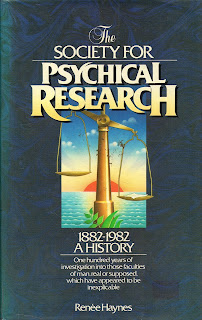
Sunday 20 February 2022 marks the 140th anniversary of the founding of the Society for Psychical Research in 1882 (on a Monday).  It’s not a satisfyingly round number, like a centenary or a sesquicentenary, but it seems worth marking nonetheless.  I’m sure in ten years’ time there will be significant celebrations, as there were in 1982 when there was a big conference at Cambridge, a series of books published by Heinemann on various aspects of psychical research, a collection of essays edited by Ivor Grattan-Guinness, and a history of the SPR written by Renée Haynes.

Grattan-Guinness’s Psychical Research: A Guide to its History, Principles and Practices provides a handy overview of its subject matter as it was viewed in 1982, containing contributions from some eminent names in the field.  One part discusses topics seen to constitute the range of psychical phenomena – mediumship, out-of-body experiences, apparitions, clairvoyance and telepathy, survival after death, poltergeists, psychic healing, precognition, psychokinesis and photography (Kirlian photography would nowadays be excluded) – and these could easily slot into a contemporary book, albeit with developments in experimental methods and theoretical models. 

Similarly, a contemporary overview of the relationship of psychical research to other disciplines would look much the same, with changes of emphasis (the section on computers seems quaint when set against their ubiquity now).  This is not to say psychical research has remained static over the last four decades.  Thinking about the way the Society has evolved since 1982, the title of the final chapter in Haynes’s book caught my eye: ‘Achievements. What Next?’  Naturally there is more on past achievements, of which there are many, than future prospects, but while the chapter is rambling, it provides a useful benchmark for measuring the subject’s evolution.

To begin with, Haynes detects an essential continuity, despite swings in intellectual fashions, since the Society was founded.  That is reasonable, as its objects are largely the same as they were in 1882, albeit the means of studying them have evolved.  However, she notes modifications in attitude.  Even by 1982, she felt ‘the pendulum has jolted from an overwhelming interest in mediums and their psychology to an overwhelming interest in the use of mass experiments evaluated by statistical methods’; from scrutiny of environmental and emotional causes of poltergeists to research on meditators and ‘psychokinetically-gifted people’ (the inclusion of emotional in relation to poltergeists is surprising, a pendulum that has swung back); and with the continuing trend towards what Haynes somewhat sniffily characterises as ‘the technology of psi.’

Her assessment of mediumship now seems unduly pessimistic, with a great deal of research being carried out into this and other aspects of the possible survival of consciousness after bodily death.  She does mention super-psi as a view gaining traction, linking it to clairvoyance, the latter to her mind less popular with SPR members in the UK than in other countries, particularly the US and France.  Super-psi is an idea that is posited as an alternative to survival (Stephen Braude is a notable champion), but it is doubtful there are national preferences for clairvoyance.  Final answers on survival she believed were beyond psychical research to determine, a familiar view today.  Technology provides useful tools for the exploration of possible psi processes.

Some elements of serious psychical research she includes in her roundup have since fallen out of fashion, such as metal bending and the Cox minilab.  Others have endured, though methods may have achieved a greater degree of sophistication since 1982.  There is still interest in anthropology (having picked up the label of paranthropology to define its intersection with the paranormal), folklore, biology and historical studies.  Considerable resources have been devoted to precognition research, and much debate generated, over the years.  It is unlikely a modern book on psychical research would devote nearly a page, as Haynes does, to Nostradamus.  On the other hand, the philosophical implications of the nature of time are as strongly debated.

As she was writing a history of the SPR rather than psychical research there is much that is skimmed over, or missing entirely.  Some areas of neglect are surprising – psychic archaeology for example – others less so, because the SPR had little involvement, such as developments in the Soviet Union.  Occult links and the vexed relationship with Spiritualists are passed over probably because of Haynes’s own views.  EVP, dismissed by her as a ‘vogue’, is widely researched, having expanded its scope to encompass ITC.  Out-of-body experiences are present, but not near-death experiences, in 1982 a major omission.  Healing, given a section in Grattan-Guinness’s book, is ignored.  She deals with reincarnation, shortly to become a growth area, in a few lines.  As an indication of the higher profile it now has, and perhaps a degree of patrician disdain, she does not refer to the campaign waged by pseudo-sceptics/counter-advocates, despite the Committee for the Scientific Investigation of Claims of the Paranormal having been formed in 1976.

Moving on to what psychical research has achieved in a hundred years, she notes the formation of similar societies in other countries and the occasional foreign SPR president.  The number of organisations and university departments concerned with psychical research has grown further since then.  Some areas, such as animal migration, she considers to have largely been solved, though not that of ‘psi-trailing’, where an animal can find its way across long distances to owners who may have moved.  There has been further work on anpsi, and the research of Rupert Sheldrake has looked extensively at psychic connections between animals and humans.

Dowsing she feels may have a magnetite component, which would supply a physical explanation, but would not apply, she concedes, to map dowsing.  Little controlled dowsing research has been carried out in the field during the last four decades, and much remains anecdotal, though Elizabeth Mayer’s claim to have recovered her daughter’s stolen harp with the help of map dowsing has been taken by some as evidence for its validity.  Thought transference morphed into telepathy and is studied, unlike Reichenbach phenomena, present in the 1882 Objects, which had vanished from serious consideration long before 1982.  Haynes says she considers psychokinesis proven, both experimentally and from spontaneous cases, and much more work has been carried out subsequently, without universal acceptance of the results.

Psychical researchers took mesmerism and, as hypnosis, cleared away its occult accretions and misinterpretations, and put it on a sound footing, meaning it has largely disappeared from psychical research outside amateur regression sessions.  Apparitions, and haunted places, have shown longevity, being investigated now as they were in 1882 and 1982.  Unfortunately, while there are greater numbers doing the investigating, many take their cue from television rather than the scholarly literature, and despite much ink and ingenious speculation being devoted to the topic, little real progress has been made.

Of hard science, Haynes mentions physics mainly in connection with the observer effect, the strangeness of some of physics’ findings acting as a gateway for strangeness in psychical research.  Awareness of the potential implications has increased enormously, with SPR vice-president Bernard Carr arguing that physics can provide the foundation for an expanded science bringing together matter, mind and spirit into a fuller understanding of the universe and our place within it.  There has been an increased interest in consciousness studies and their philosophical implications since 1982.

Haynes is out of sympathy with laboratory work, questionnaires, and the use of statistics, claiming, in her colourful way, that ‘The processes involved seem to resemble those of plucking, cleaning, and boiling a chicken down for stock.  The end product may be wholesome and nourishing; but nothing characteristic of the original remains, life, colour, shape are gone, regarded as irrelevant.’ (p. 165)  The resulting generalisations and abstractions, in her view, remove the researcher from the raw experiences of individuals.  Doubtless many ploughing laboriously through number-heavy papers in parapsychological journals would agree with her.

Haynes’s greatest fear was that the use of arcane, overtechnical language (‘gobbledygook’ as she terms it) within specialisms might inhibit cross-disciplinary research and lead to ghettoisation of specialists who failed to talk to each other.  Fortunately, it can be said with confidence this danger was averted, with psychical research benefiting from debate that crosses boundaries in the search for answers.  Qualitative methods exploring lived experience are thriving too, which no doubt she would have welcomed, while rolling her eyes at laboratory testing on groups rather than individuals, allowing potential ‘stars’ to slip through the net.

As a means of assessing the current situation, a useful overview has recently been provided by Terje G. Simonsen’s A Short History of (Nearly) Everything Paranormal.  Much would have been familiar to Haynes, including his central idea of the Mental Internet.  Crucially, though, he outlines three main approaches to our relationship to psi, focusing on laboratory, nature and spirituality, the last of the three seeking to comprehend ways in which our everyday existence, including psi, is part of a greater whole.  This issue was not addressed by Haynes, but it has become much more prominent since the publication of her book, as is evidenced by the foundation of organisations like the Scientific and Medical Network and IONS, specifically incorporating a spiritual element into their programmes, and the overlap of psychical research with transpersonal psychology.

It can be said that psychical research has progressed significantly since 1982, but with much still to do.  As for the future, the growth of computing, and specifically the Internet, in the last couple of decades has made an enormous difference to the way the SPR now operates. With electronic communication has come a greater ability to reach out and fulfil a core principle of the SPR’s charitable status, that of education.  Rather than talking mainly to a small group of like-minded individuals, it is now possible to disseminate the data of the SPR, and psychical research generally, in a way not foreseen in 1982.  This has opened up opportunities for cross-fertilisation of ideas that can only be helpful.  Grattan-Guinness’s geographical breakdown has four sections: Britain, Europe, Russia and the Soviet Union, and the United States, as if there was nothing to be said about other regions.  Thanks to the Internet, the conversation can now be global.

Haynes famously coined the term ‘boggle threshold’, and in the introduction to her centenary history (p. ix) defines it as ‘the level above which the mind boggles when faced by some new fact or report or idea.’  Phenomena are judged on a case-by-case basis, and her threshold was fairly high for some, much lower for others.  Evidence will become stronger or weaker, and boggle thresholds rise and fall, as psychical research evolves.  In the process, topics leave the field, as the Reichenbach phenomena did, while others enter it, as methods increase in sophistication even if underfunding remains constant.  In 1982 Haynes concluded with the words, ‘here’s to the next hundred years,’ and to that sentiment one can happily raise a glass.


References

Grattan-Guinness, Ivor (ed.). Psychical Research: A Guide to its History, Principles and Practices. In Celebration of 100 Years of the Society for Psychical Research. Wellingborough: The Aquarian Press, 1982.

Haynes, Renée. The Society for Psychical Research 188201982: A History. London: Macdonald, 1982.

Mayer, Elizabeth. Extraordinary Knowing: Science, Skepticism and the Inexplicable Powers of the Human Mind. New York: Bantam, 2007.

Simonsen, Terje G.. A Short History of (Nearly) Everything Paranormal: Our Secret Powers – Telepathy, Clairvoyance & Precognition. London: Watkins, 2020.