Sunday, 20 February 2022

The Society for Psychical Research at 140


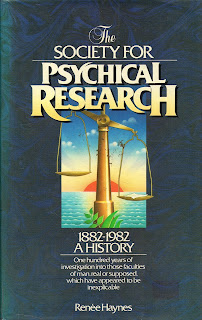
Sunday 20 February 2022 marks the 140th anniversary of the founding of the Society for Psychical Research in 1882 (on a Monday).  It’s not a satisfyingly round number, like a centenary or a sesquicentenary, but it seems worth marking nonetheless.  I’m sure in ten years’ time there will be significant celebrations, as there were in 1982 when there was a big conference at Cambridge, a series of books published by Heinemann on various aspects of psychical research, a collection of essays edited by Ivor Grattan-Guinness, and a history of the SPR written by Renée Haynes.

Grattan-Guinness’s Psychical Research: A Guide to its History, Principles and Practices provides a handy overview of its subject matter as it was viewed in 1982, containing contributions from some eminent names in the field.  One part discusses topics seen to constitute the range of psychical phenomena – mediumship, out-of-body experiences, apparitions, clairvoyance and telepathy, survival after death, poltergeists, psychic healing, precognition, psychokinesis and photography (Kirlian photography would nowadays be excluded) – and these could easily slot into a contemporary book, albeit with developments in experimental methods and theoretical models. 

Similarly, a contemporary overview of the relationship of psychical research to other disciplines would look much the same, with changes of emphasis (the section on computers seems quaint when set against their ubiquity now).  This is not to say psychical research has remained static over the last four decades.  Thinking about the way the Society has evolved since 1982, the title of the final chapter in Haynes’s book caught my eye: ‘Achievements. What Next?’  Naturally there is more on past achievements, of which there are many, than future prospects, but while the chapter is rambling, it provides a useful benchmark for measuring the subject’s evolution.

To begin with, Haynes detects an essential continuity, despite swings in intellectual fashions, since the Society was founded.  That is reasonable, as its objects are largely the same as they were in 1882, albeit the means of studying them have evolved.  However, she notes modifications in attitude.  Even by 1982, she felt ‘the pendulum has jolted from an overwhelming interest in mediums and their psychology to an overwhelming interest in the use of mass experiments evaluated by statistical methods’; from scrutiny of environmental and emotional causes of poltergeists to research on meditators and ‘psychokinetically-gifted people’ (the inclusion of emotional in relation to poltergeists is surprising, a pendulum that has swung back); and with the continuing trend towards what Haynes somewhat sniffily characterises as ‘the technology of psi.’

Her assessment of mediumship now seems unduly pessimistic, with a great deal of research being carried out into this and other aspects of the possible survival of consciousness after bodily death.  She does mention super-psi as a view gaining traction, linking it to clairvoyance, the latter to her mind less popular with SPR members in the UK than in other countries, particularly the US and France.  Super-psi is an idea that is posited as an alternative to survival (Stephen Braude is a notable champion), but it is doubtful there are national preferences for clairvoyance.  Final answers on survival she believed were beyond psychical research to determine, a familiar view today.  Technology provides useful tools for the exploration of possible psi processes.

Some elements of serious psychical research she includes in her roundup have since fallen out of fashion, such as metal bending and the Cox minilab.  Others have endured, though methods may have achieved a greater degree of sophistication since 1982.  There is still interest in anthropology (having picked up the label of paranthropology to define its intersection with the paranormal), folklore, biology and historical studies.  Considerable resources have been devoted to precognition research, and much debate generated, over the years.  It is unlikely a modern book on psychical research would devote nearly a page, as Haynes does, to Nostradamus.  On the other hand, the philosophical implications of the nature of time are as strongly debated.

As she was writing a history of the SPR rather than psychical research there is much that is skimmed over, or missing entirely.  Some areas of neglect are surprising – psychic archaeology for example – others less so, because the SPR had little involvement, such as developments in the Soviet Union.  Occult links and the vexed relationship with Spiritualists are passed over probably because of Haynes’s own views.  EVP, dismissed by her as a ‘vogue’, is widely researched, having expanded its scope to encompass ITC.  Out-of-body experiences are present, but not near-death experiences, in 1982 a major omission.  Healing, given a section in Grattan-Guinness’s book, is ignored.  She deals with reincarnation, shortly to become a growth area, in a few lines.  As an indication of the higher profile it now has, and perhaps a degree of patrician disdain, she does not refer to the campaign waged by pseudo-sceptics/counter-advocates, despite the Committee for the Scientific Investigation of Claims of the Paranormal having been formed in 1976.

Moving on to what psychical research has achieved in a hundred years, she notes the formation of similar societies in other countries and the occasional foreign SPR president.  The number of organisations and university departments concerned with psychical research has grown further since then.  Some areas, such as animal migration, she considers to have largely been solved, though not that of ‘psi-trailing’, where an animal can find its way across long distances to owners who may have moved.  There has been further work on anpsi, and the research of Rupert Sheldrake has looked extensively at psychic connections between animals and humans.

Dowsing she feels may have a magnetite component, which would supply a physical explanation, but would not apply, she concedes, to map dowsing.  Little controlled dowsing research has been carried out in the field during the last four decades, and much remains anecdotal, though Elizabeth Mayer’s claim to have recovered her daughter’s stolen harp with the help of map dowsing has been taken by some as evidence for its validity.  Thought transference morphed into telepathy and is studied, unlike Reichenbach phenomena, present in the 1882 Objects, which had vanished from serious consideration long before 1982.  Haynes says she considers psychokinesis proven, both experimentally and from spontaneous cases, and much more work has been carried out subsequently, without universal acceptance of the results.

Psychical researchers took mesmerism and, as hypnosis, cleared away its occult accretions and misinterpretations, and put it on a sound footing, meaning it has largely disappeared from psychical research outside amateur regression sessions.  Apparitions, and haunted places, have shown longevity, being investigated now as they were in 1882 and 1982.  Unfortunately, while there are greater numbers doing the investigating, many take their cue from television rather than the scholarly literature, and despite much ink and ingenious speculation being devoted to the topic, little real progress has been made.

Of hard science, Haynes mentions physics mainly in connection with the observer effect, the strangeness of some of physics’ findings acting as a gateway for strangeness in psychical research.  Awareness of the potential implications has increased enormously, with SPR vice-president Bernard Carr arguing that physics can provide the foundation for an expanded science bringing together matter, mind and spirit into a fuller understanding of the universe and our place within it.  There has been an increased interest in consciousness studies and their philosophical implications since 1982.

Haynes is out of sympathy with laboratory work, questionnaires, and the use of statistics, claiming, in her colourful way, that ‘The processes involved seem to resemble those of plucking, cleaning, and boiling a chicken down for stock.  The end product may be wholesome and nourishing; but nothing characteristic of the original remains, life, colour, shape are gone, regarded as irrelevant.’ (p. 165)  The resulting generalisations and abstractions, in her view, remove the researcher from the raw experiences of individuals.  Doubtless many ploughing laboriously through number-heavy papers in parapsychological journals would agree with her.

Haynes’s greatest fear was that the use of arcane, overtechnical language (‘gobbledygook’ as she terms it) within specialisms might inhibit cross-disciplinary research and lead to ghettoisation of specialists who failed to talk to each other.  Fortunately, it can be said with confidence this danger was averted, with psychical research benefiting from debate that crosses boundaries in the search for answers.  Qualitative methods exploring lived experience are thriving too, which no doubt she would have welcomed, while rolling her eyes at laboratory testing on groups rather than individuals, allowing potential ‘stars’ to slip through the net.

As a means of assessing the current situation, a useful overview has recently been provided by Terje G. Simonsen’s A Short History of (Nearly) Everything Paranormal.  Much would have been familiar to Haynes, including his central idea of the Mental Internet.  Crucially, though, he outlines three main approaches to our relationship to psi, focusing on laboratory, nature and spirituality, the last of the three seeking to comprehend ways in which our everyday existence, including psi, is part of a greater whole.  This issue was not addressed by Haynes, but it has become much more prominent since the publication of her book, as is evidenced by the foundation of organisations like the Scientific and Medical Network and IONS, specifically incorporating a spiritual element into their programmes, and the overlap of psychical research with transpersonal psychology.

It can be said that psychical research has progressed significantly since 1982, but with much still to do.  As for the future, the growth of computing, and specifically the Internet, in the last couple of decades has made an enormous difference to the way the SPR now operates. With electronic communication has come a greater ability to reach out and fulfil a core principle of the SPR’s charitable status, that of education.  Rather than talking mainly to a small group of like-minded individuals, it is now possible to disseminate the data of the SPR, and psychical research generally, in a way not foreseen in 1982.  This has opened up opportunities for cross-fertilisation of ideas that can only be helpful.  Grattan-Guinness’s geographical breakdown has four sections: Britain, Europe, Russia and the Soviet Union, and the United States, as if there was nothing to be said about other regions.  Thanks to the Internet, the conversation can now be global.

Haynes famously coined the term ‘boggle threshold’, and in the introduction to her centenary history (p. ix) defines it as ‘the level above which the mind boggles when faced by some new fact or report or idea.’  Phenomena are judged on a case-by-case basis, and her threshold was fairly high for some, much lower for others.  Evidence will become stronger or weaker, and boggle thresholds rise and fall, as psychical research evolves.  In the process, topics leave the field, as the Reichenbach phenomena did, while others enter it, as methods increase in sophistication even if underfunding remains constant.  In 1982 Haynes concluded with the words, ‘here’s to the next hundred years,’ and to that sentiment one can happily raise a glass.


References

Grattan-Guinness, Ivor (ed.). Psychical Research: A Guide to its History, Principles and Practices. In Celebration of 100 Years of the Society for Psychical Research. Wellingborough: The Aquarian Press, 1982.

Haynes, Renée. The Society for Psychical Research 188201982: A History. London: Macdonald, 1982.

Mayer, Elizabeth. Extraordinary Knowing: Science, Skepticism and the Inexplicable Powers of the Human Mind. New York: Bantam, 2007.

Simonsen, Terje G.. A Short History of (Nearly) Everything Paranormal: Our Secret Powers – Telepathy, Clairvoyance & Precognition. London: Watkins, 2020.


Monday, 29 November 2021

Thirty Years, on and off, in the Parapsychological Association


The Parapsychological Association (PA) is an organisation aimed primarily at those, from whatever discipline, who are studying parapsychology in order to advance a scientific understanding of it, and to facilitate dissemination of that understanding.  It brings together professionals working in the field with those who have a general interest.  The PA was founded in 1957, and in 1969 became affiliated to the American Association for the Advancement of Science.  Most members are drawn from the US and to a lesser extent Western Europe, though other regions, particularly South America, are increasingly represented.

I first joined the PA thirty years ago.  My welcome letter, dated 23 August 1991, was signed by John Palmer, then chairman of the membership committee, and soon to be President, who welcomed me as an associate member.  Enclosed with the letter was the Fall 1990 issue of PA News – a four-page newsletter edited by Nancy Zingrone – a small booklet containing the 1990 members’ directory, two pages on the PA’s aims and organisation, and a publicity leaflet.

My application reference was provided by PA associate, and the Society for Psychical Research’s Hon. Secretary, Arthur Oram, who had also recommended me for co-optation to the SPR’s Council the previous year.  The wheels turned slowly in those pre-internet days, as Arthur’s letter saying he was going to send a reference to the PA was dated 9 January 1991, so it took a further eight months for me to be told my application had been successful.  The subscription was $35.

I only seem to have remained in the PA until 1997, judging by the contents of my file, after which I left because I didn’t feel I was getting much for the subscription, not being in a position to attend the annual conventions, as PA conferences are termed.  Members were supposed to receive the annual Research in Parapsychology, but I recall publication being patchy, so apart from the magazine I had little to show for the money.

In the first issue of the newsletter I received, Nancy Zingrone had asked for suggestions for a better title than PA News.  By the time I left it was still called that, though the size had increased to 12 pages.  It would be nice to see a set of these historical documents digitised on the PA website, or perhaps included in the Lexscien online library (the PA is a partner organisation and Research in Parapsychology is already held in Lexscien).

During the early 2010s I re-joined for several years when doing postgraduate research, but left again when that finished and I was no longer eligible for the student rate.  However, I had always maintained an interest in the PA and was impressed by the number of online activities it had undertaken during the pandemic – lectures, symposia, the convention (this year in association with the Society for Scientific Exploration) and a monthly virtual meet-up, the Psi Agora.  So in March this year I decided to join for the third time, along with quite a few others I understand: like the SPR, membership has risen during the last couple of years as online events, accessible to members everywhere, have increased in number.

Comparing the PA in the early 1990s with today, I discovered that the PA’s membership categories have been rejigged to make them more inclusive.  In 1991 they were: honorary member (which was by invitation) full member, associate member, affiliate, and student affiliate.  Even affiliates had to have full membership of a professional organisation in an academic field (associates had to have an advanced university degree, and I had an MA in Modern European Thought, hence being admitted to that category).

Now the categories are: honorary member, professional member, associate member, supporting member and student member.  The conditions for professional membership have become more clearly delineated, though anybody who was eligible for full membership then would still be elected to professional membership.  Achieving an associateship is slightly harder than it used to be, with two criteria to be met rather than one.

However, where the old affiliate had to be a full member of a professional organisation, supporting member (my category now) includes anyone ‘who has an interest in the scientific and scholarly advancement of parapsychology,’ with no academic requirement.  Like the old affiliates, supporting members do not have voting rights, but whereas affiliates and associates paid the same, and professional members paid more, these days supporting members, associates and professional members are all charged the identical rate (currently $100).

An obvious difference in the last 30 years is in the evolution of the PA News into the beautifully-produced Mindfield.  It debuted in 2009 and is a valuable addition to the Journal of Parapsychology, which is circulated to members (the default for both is digital, with paper copies costing extra).  The PA has extended its activities to include career awards, book awards, a mentorship programme for student members, and general information on parapsychology provided through its website.

In addition to the PA’s direct undertakings, it is worth mentioning that Analisa Ventola, its Executive Director, has recently developed Public Parapsychology, previously a blog, into an online forum to encourage networking.  While it is still in its early stages, it promises to bring in non-PA members to explore parapsychological issues, and perhaps in turn encourage them to consider joining the PA. 

For anybody with a serious interest in parapsychology I would recommend PA membership.  There is a collegiate feel, and the organisation is always seeking to find ways to push the boundaries of the discipline to demonstrate its relevance.  For a taster of its scope and approach, there are many PA talks on YouTube.  The cost of membership may be a deterrent for some, but the rewards are worth the subscription.  Those who join both the PA and the SPR are eligible for a reduction on their subscriptions, making membership even better value, and supporting two important organisations in the process.

Tuesday, 16 November 2021

The $1.8 million Bigelow Competition


Robert Bigelow is a successful businessman with an interest in parapsychology and UFOs, and for a decade he was owner of the notorious Skinwalker ranch.  Like others who have suffered personal loss (the deaths of his 24-year-old son in 1992, his 20-year-old grandson in 2011, and his wife in February 2020), he developed an interest in life after death.  In June 2020 he founded the Bigelow Institute for Consciousness Studies (BICS), though he didn’t spend much money on its website.

Rather than an interest in aspects of consciousness per se, as the name might imply, BICS’ primary purpose is to ‘support research into both the survival of human consciousness after physical death and, based on data from such studies, the nature of the afterlife.’  Importantly, it is ‘seeking hard evidence “beyond a reasonable doubt” that takes us beyond religion or philosophy.’  There have been efforts in this direction for more than a century and a half, but fresh attempts are always welcome.

This is not Bigelow’s first foray into the issue of survival: in 1997 he and his wife endowed a chair in consciousness studies at the University of Nevada, at a cost of $3.7 million.  Charles Tart and Raymond Moody, well known for work in transpersonal psychology and near-death experiences (among other topics) respectively, were the first chairs but, disillusioned by a lack of progress, Bigelow eventually terminated the endowment.  He founded BICS because, in an interview with Leo Ruickbie, editor of the Magazine of the Society for Psychical Research, he said he had decided the field needed ‘energising’.

 In January 2021, BICS announced a competition for essays summarising the best scientific evidence for the survival of human consciousness after bodily death.  Prize money totalling $1 million was announced, though the amount was later increased, and $1.8 million was eventually awarded.  As the BICS website put it, ‘‘The purpose of the BICS essay contest is to generate research, discussion and stimulate debate. And perhaps in so doing, BICS may substantially broaden the amount of quality information available to you from a single website source.’  When the story broke in the New York Times, unsurprisingly it attracted a great deal of attention.  The deadline for essay submissions was 1 August 2021.

So why a competition rather than some other method of promoting research?  In the interview with Ruickbie, Bigelow stated: ‘It’s a faster path, creating a contest.  You can achieve greater acceleration and awareness – and that was my objective, to accelerate awareness of the topic. So I thought, let’s have this contest, it’s a way to begin. It hasn’t been done before, certainly at least not at this scope. And what could it hurt, if it were properly put together?’

The amounts on the table were eye-watering in a field notoriously strapped for cash.  The top three winners would trouser a cool $500,000, $300,000 and $150,000, with smaller, but still respectable, prizes for the runners-up.  The judges were Jeffrey J Kripal, Leslie Kean, Christopher C Green, Brian Weiss, Jessica Utts and Hal Puthoff (all from the United States).  They also serve on BICS’ board of directors.  Apart from Green, these are familiar, and to varying degrees eminent, names in the field.

Such a rich offering was bound to tempt opportunists and cranks, so rules were laid down to attract the suitably qualified and filter out the tyre-kickers.  Not anybody could enter; essayists first had to demonstrate they were serious researchers, with proof of at least five years study in the field, and preferably affiliation to a reputable organisation (the Society for Psychical Research was given as an example).  Entries relying on religious doctrine would not be accepted because, as Bigleow told Ruickbie, ‘anybody can quote scripture, so that’s too sophistic to accept.’  Essays were limited to a maximum of 25,000 words, to weed out those who thought quantity would be a substitute for quality.

Even with the rules to guide them, plenty of people either thought they could furnish convincing evidence for the continuation of consciousness after death, or assumed the competition’s criteria were not as stringent as BICS had indicated.  Over 1,300 people decided to try their hand, of which 205 from 38 countries were shortlisted.  Amusingly, according to an acknowledgement by Bigelow on the BICS website noting the number of entrants, some people sent him ‘gifts’, and one can only assume these were intended as bribes.

The winners were announced on 2 November 2021.  There were 29 listed, the three top prizes plus 11 given $50,000 each and 15 $20,000 each.  Considering the scope of the competition and the importance Bigleow had attached to it, it was all very muted; in fact, the list of winners was published a day later than scheduled, with no explanation, and no fanfare.  There is going to be a ceremony to present the awards in Las Vegas on 4 December 2021, but it may feel a little anticlimactic coming so long after the winners’ names were announced.

Jefrrey Mishlove, host of the Thinking Allowed/New Thinking Allowed interview series, took home the $500,000.  A few of the essays were joint efforts, so a total of 43 individuals will share the money.  These are the 29 named winners, most, as one would expect, well-known in psychical research circles:

1st Prize: Jeffrey Mishlove, $500,000
2nd Prize: Pim van Lommel, $300,000
3rd Prize: Leo Ruickbie, $150,000

Runners-up ($50,000 each): Michael Tymn, Stephen Braude, Nicolas Rouleau, Bernardo Kastrup, Elizabeth Krohn, Sharon Rawlette, Jeffrey Long, Michael Nahm, Julie Beischel, Alexandre Rocha et al., David Rousseau et al.

Honorable Mentions ($20,000 each): Robert Mays et al, Chris Carter, Steve Taylor, Christopher Kerr, Bruce Leininger, Vernon Neppe, Helané Wahbeh et al, Chris Roe et al, Peter Fenwick et al, Walter Meyer zu Erpen, Akila Weerasekera, Greg Taylor, Nick Cook, Andreas Sommer, Sam Parnia et al.

The first essay to be published (by himself rather than BICS) is Mishlove’s, offering an early opportunity to see how the winner interpreted the aims of the competition, and a standard by which to judge the rest.  It is certainly lovingly put together, a multimedia presentation drawing on his extensive Thinking Allowed and New Thinking Allowed interviews, with links to segments of the films amplifying the text, and it is copiously illustrated.

It is titled Beyond the Brain: The Survival of Human Consciousness After Permanent Bodily Death (not to be confused with the long-running Beyond the Brain conferences organised by the Scientific and Medical Network).  In it, Mishlove has produced a kind of psychical research’s greatest hits, albeit necessarily selective and somewhat superficial, drawing on his interviews and mixing personal testimony and scholarship.

In the introductory section he recounts a powerful personal experience which convinced him of survival.  He notes the problems parapsychology has had achieving recognition as a valid scientific discipline and, championing metaphysical idealism (for which he relies heavily on the work of Bernardo Kastrup), lays out reasons for taking the survival evidence seriously.  He goes on, adopting a ‘bundle of sticks’ approach, to discuss what he considers the most important themes: near-death experiences, after-death communications, reincarnation, Peak in Darien cases, possession, instrumental transcommunication, xenoglossy, and mental and physical mediumship, plus miscellaneous topics such as psychedelics, terminal lucidity, the filter theory, and criticisms of the living agent psi hypothesis.

Whether one is convinced by his essay rather depends whether one had previously been convinced by his many interviews.  The essay adds little to that body, and he could be accused of recycling his previous work, remarkable though the number of his interviewees and the range of subjects discussed over the years have been.  He has compiled a useful introduction to the various strands adduced by researchers suggestive of survival, but if he had been given a book deal for this material, he would not have received $500,000 for it.

It is an interesting, wide-ranging and accessible read, but the tone of much of it feels like a distillation of the SPR’s Psi Encyclopedia.  I was hoping for some twist, something which broke new ground in our efforts to determine whether or not there is post-mortem continuation of consciousness, but came away disappointed.  Mishlove has contributed hugely to the field, and this award felt a little like the actor who wins an Oscar for a particular role which is not their best work, but really as covert recognition of a career’s achievement.

One can see why, though, Bigelow would have been happy with Mishlove’s approach, because their views align closely.  In the interview with Ruickbie, Bigelow contends: ‘materialism has become another religion, science has become another religion. That has dominated the twentieth century and probably will do so for the rest of this century.’  After Ruikbie asks for his thoughts on consciousness, he says in part, ‘Thought is key, so even forming the universe, if we want to go out on the super macro scale,’ and he espouses the same filter theory of the brain as Mishlove.  Mishlove argues that ‘Metaphysical idealism is the most logically consistent position as it eliminates the problems of both materialism and dualism,’ and he is critical of scientism.

Mishlove’s and the other winning entries will be placed on the Bigelow website in due course.  They will also be published in 5-6 volumes intended to be ‘collector’s items’, and ‘each volume will be hard cover, richly bound in faux leather with gilted pages and ribbons’, which sounds lovely.  These will be distributed free to university libraries, hospices (which should cheer the residents up) and some religious institutions.  Unfortunately, the print format will work against Mishlove’s careful selection of videos to complement his text.

In addition to the winning entries, we can expect to see losing entries finding their way into the public arena.  Some are already available, such as James Beichler’s and Tom Butler’s.  Anthony Peake for some reason has chosen to read his out in a series of YouTube videos.  We can expect quite a few of those papers which did not place to circulate in the coming months, so those who agree with Bigelow on the importance of the survival issue will have plenty to chew on in addition to the canonical 29, and they will offer an opportunity to assess the losers against the winners to see how they compare.

Ian Wardell’s initial thought following the announcement of the winners was that, because of the way the terms of reference were framed, ‘My suspicion is that most of these essays will largely regurgitate the evidence that is already out there and will do little to persuade skeptics.’  Such was predictable, as the competition sought ‘papers that summarize the best evidence available for the survival of human consciousness after permanent bodily death.’  It will be interesting to see whether any of the other winning entries actually dig deeper or are rather ‘the best of the rest’, a procession of summaries of already-available data.

If it turns out Mishlove’s is indeed the best, it will be hard to escape the conclusion that while Bigelow may have achieved his goal of providing a pool of information and generating debate, the examination of the survival of bodily death has not advanced further.  On the other hand, Michael Tymn, a runner-up, saw the problem with the competition differently, believing the necessary evidence had already been accumulated as long ago as 1920, and any gathered since is merely ‘icing on the cake’.  By that standard, the competition was bound not to produce anything new.

So, did Mr Bigelow get his money’s-worth?  Based on Mishlove’s essay I would say not.  I’m sure he has made 43 people very happy, but I can’t help feeling the field would have been better served if he had set up a grant-giving foundation (with a larger pool of referees) and handed out smaller sums on a more sustainable basis for specific projects that help to progress our understanding, rather than make a big gesture for a handful of essays retreading old ground.  An organisation like the SPR could I’m sure have done a lot with nearly $2 million.

It does seem likely Bigelow will continue to put money into survival research, judging by his remarks to Ruickbie.  Asked what next, he replies: ‘We’ll be thinking about 2022, as to what we can do for that year. Is it going to be another contest? Is it going to be something that is going to involve some of the applicants, some of the people generating these essays? We would want to come up with something that certainly wasn’t just a repeat. We’re interested in ideas as to what could constitute a new kind of contest for 2022.’

One hint he threw out is that he wants to extend his effort from asking whether consciousness survives bodily death to trying to determine what ‘the other side’ is like, as the next logical step – the second strand of the Institute’s aims, according to its website.  Only time will tell if the generous sums of money Bigelow is sinking into research have produced worthwhile results, and really moved the field forward significantly.


References

Beichler, James E. ‘Best Evidence for the Afterlife is Something to Die for’, Academia.Edu, 2021. Retrieved 12 November 2021.

The Bigelow Institute for Consciousness Studies, https://bigelowinstitute.org/index.php

Blumenthal, Ralph. ‘Can Robert Bigleow (and the Rest of Us) Survive Death?’ New York Times, 21 January 2021. Retrieved 5 November 2021.

Butler, Tom. ‘Case for the Survival Hypothesis’, Tom Butler’s Etheric Studies, November 2021. Retrieved 13 November 2021.

Mishlove, Jeffrey. Beyond the Brain: The Survival of Human Consciousness After Permanent Bodily Death. 2021.

Ruickbie, Leo. ‘Death: The Final Frontier’, Fortean Times, issue 405, May 2021, pp. 36-39. Reprinted as ‘The $1,500,000 Question: Is there Life After Death?’ in The Magazine of the Society for Psychical Research, issue 3, 2021, pp. 4-7.

Society for Psychical Research, The Psi Encyclopedia, https://psi-encyclopedia.spr.ac.uk/

Tymn, Michael. ‘Aerospace Magnate Robert Bigelow Searches for Answers on Life After Death’, White Crow Books, 8 November 2021. Retrieved 9 November 2021.

Wardell, Ian. ‘Bigelow Competition for the Best Essay on the Evidence for an Afterlife.’ Ian Wardell: Philosophical Thoughts, 10 November, 2021. Retrieved 11 November 2021.

Friday, 8 October 2021

Forty Years of Society for Psychical Research Magazines


In March 2021, the Society for Psychical Research’s Paranormal Review changed its name to The Magazine of the Society for Psychical Research.  This is the latest in a succession of titles the SPR’s magazine has had over the course of the last four decades, the production values improving with each iteration.  Unfortunately, the first attempt at a more accessible publication to supplement the often rather technical articles in the SPR’s Journal and Proceedings became mired in controversy.

In 1980 a report appeared in the SPR’s Journal ominously headed ‘Activities of the Publications Committee (now suspended)’.  This detailed how said committee had embarked on a publishing programme without consulting the SPR’s Council, incurring significant expenditure at a time when the Society was facing financial difficulties, and producing items of poor quality.  These items, not actually of poor quality, were a number of introductory booklets, the costs of which went wildly over budget (the committee was also responsible for beginning the project to produce a series of centenary publications, edited by Brian Inglis and released in 1982, which were extremely successful).

A Council working party was set up to examine the Publications Committee’s activities, and the fall-out was in part an impetus for the decision by some members to set up the rival Association for the Scientific Study of Anomalous Phenomena (ASSAP), founded in 1981.  In the Journal report is a reference to ‘a Newsletter (which was withdrawn as unsuitable before distribution).’  This was the SPR Bulletin, dated Spring 1980.  Described in an editorial as ‘something of an experiment,’ it is not difficult to see why the conservative SPR old guard were unhappy.

The Bulletin’s editorial was unsigned but was written by Hugh Pincott, the SPR’s Hon. Secretary, who was to become a founder of ASSAP.  It noted that communication within the Society was a concern, and the Bulletin was designed as a ‘meeting-place’ both for members and for a proposed network of regional research groups (it was to assist the anticipated influx of new members resulting from this effort that the publishing programme had been undertaken).

The idea of regional affiliated groups has always been treated with ambivalence by the SPR Council, partly because of potential image damage if a local group generated negative press, and partly because of discomfort with the loss of centralised control.  It is not difficult to see why there was unease among some on Council at the prospect of an autonomous national network affiliated to the London organisation but with no regulatory mechanism in place.

The general tone of the four-page newsletter was chatty and approachable.  Alongside the editorial was a photograph from a 1927 psychical research congress, with a rather sexist text, and an announcement by the London & Home Counties Poltergeist Group that it welcomed new members.  Page two would have caused further discomfort to some of the more staid Council members.  Written by Hilary Evans and Kevin McClure, again to be ASSAP stalwarts though Evans continued to serve on the Council, it announced the arrival of ‘The SPR UFO Study Group’.  The first paragraph refers to ‘the first formal contact between the SPR and ufology, in the shape of a joint symposium with BUFORA’ held on 3 November 1979.

The study group was established following the circulation of an internal report, The UFO Phenomenon: An Assessment, in January 1979.  This was prepared as the result of a conclusion reached by Council at the end of 1978 that, as the opening of The UFO Phenomenon’s introduction states, ‘there was at least a prima facie case for regarding the problem of Unidentified Flying Objects, as least in some of its aspects, as a legitimate area for the Society’s interest.’  In the event interest quickly petered out, the UFO Study Group was never again referred to in SPR literature, and some years later the SPR’s collection of UFO literature was donated to ASSAP as being outside the SPR’s field of interest.

The other two pages of the Bulletin show the type of material it was expected to carry.  A proposed ‘true experiences’ column was kicked off by Brian C Nisbet describing ‘an auditory hypnopompic hallucination,’ an experience involving a Goblin Teasmade.  ‘Home and Abroad’ recounted the activities of three members, including ghosthunter Andrew Green, who probably needed no introduction to readers, and one in Papua New Guinea.

The final page had columns on a group in Essex; veteran member Zőe Richmond; and the role of the new Research Coordinating Committee, which had consolidated previous research committees, in relation to the regional groups.  The emphasis of the new committee was on decentralising the Society’s research activities, and it stated that 18 local groups were in the process of being formed, half of them in London, as well as a number of special interest groups focusing on particular topics, with more in the pipeline.

Sadly, the Bulletin, with its grand aspirations to increase member involvement, never saw the light of day, as indicated by the rough-and-ready banner.  Instead, after a gap of nearly a year, the first issue of the SPR Newsletter, dated February 1981, was distributed to members.  Edited by Anita Gregory, the style was very different to the Bulletin.  Gone was enthusiastic talk about affiliated groups and UFOs.  Instead, the focus was top-down, the reader being assured that ‘you will be kept informed about future activities and developments,’ with no suggestion that the readers might be generating those activities themselves.


Still only four pages long, it was divided neatly into topics.  Page one contained Gregory’s brief introduction, and reports on a one-day SPR conference in Manchester and a study day in London.  Page two was devoted to forthcoming events, including the 1982 centenary conference in Cambridge, and courses offered by Susan Blackmore, Gregory and Archie Roy.

Page three dealt with research being conducted by Arthur Ellison, Blackmore, Carl Sargent, John Beloff, and Julian Isaacs.  The final page included a tribute to Ellison’s outreach efforts in lecturing around the country, an extra lecture in the programme, an appeal for information, and a list of some recent scholarly papers by academic members.  The difference between this as an information sheet and the concept of the Bulletin as a vehicle for stimulating a more democratic ethos in the Society is clear.

Gregory only intended to edit the first issue.  The editor for the second and most of the 35 issues of the Newsletter was Sue Blackmore.  She adopted a less patrician manner than Gregory’s, abandoned the neat divisions of activities Gregory had managed, and solicited news about activities being undertaken by members.  The pages covered events, research and publications as before, but also had information on spontaneous cases and a visit Blackmore had made to Poland.

Groups were not entirely ignored, even if not unduly emphasised.  There were a couple of paragraphs on a ‘Kent SPR’ which had recently been founded, but Blackmore admitted she had not heard from any other groups (this despite the substantial numbers mentioned in the Bulletin) and invited them to get in touch with their news.  Peter Hallson took on the role of Regional Groups Administrator, but his was very much a passive role, restricted to phoning local organisations once a year to see if they were still active.  ‘Regional groups’ referred to independent groups out in the regions, not regional subsidiaries of the SPR.

Subsequent issues under Blackmore’s editorship maintained the mix of news items, announcements, requests, and reports of events.  Julie Milton took over the editorship for two years, improving the production values and increasing the four A4 pages to eight, before handing it back to Blackmore in 1988.  A portion of the Newsletter was given over to a Supplement edited by Renée Haynes which was devoted to experiences sent in by readers.  This proved a useful feature to help fill space when Milton experienced a period of illness and the length of the Newsletter had to be temporarily reduced.

The SPR Newsletter proved popular with members, and moved from an initial publication schedule of every four months to quarterly, in line with the SPR’s Journal.  Eventually Council decided it was time to move to an improved version, with a title that gave a better idea of the contents, that might even sell to the public.  After 36 issues of the Newsletter, and 23 of the Supplement, the final one appeared in January 1991.  In the preceding issue Blackmore stated that Council had been debating whether to expand the publication or replace it with a glossy magazine, and the final issue announced that an expanded Newsletter would replace it.  The replacement was The Psi Researcher, edited by Jane Henry.


Apart from a new banner and a change from two columns per page to four, the first issue of The Psi Researcher, dated April 1991 looked much like its predecessor, with the same number of pages – eight – so hardly an expansion.  Henry even assured readers they would find ‘many familiar items’ within.  She noted that the new beginning for the publication coincided with a new beginning for the Society, as it was about to move from its secluded premises in Adam and Eve Mews to Marloes Road, a short distance away.  This was for financial reasons, so it was not a particularly auspicious time to be starting a new publishing venture.  A cover price for non-members was included from issue 2 (£1), but efforts to secure newsstand distribution proved unsuccessful.  From issue 3 the number of columns per page settled down to two.

As Henry had said, the mix was indeed much as before, though with less space devoted to event reports and more to features, and the addition of recent research abstracts compiled by Carl Williams.  It was well received, and the second fulfilled the promise of an increase in size, moving to 16 pages.  In addition to features, news, experiences, abstracts, reports and reviews, there was an account of an interview James Randi had given to Williams.  Haynes retained her section, retitled ‘Paranormal Experiences’, editing it for the first three issues until forced to give up through ill health, after which it was consolidated into the magazine, with John Crabbe eventually taking charge.

Blackmore did not disappear entirely, with a ‘Skeptics’ Corner’ in issue 2 (swiftly retitled ‘Sceptics’ Corner in issue 3), thereafter largely fading from view but making the occasional appearance, notably promoting her ‘dying brain’ hypothesis to explain NDEs in issue 6.  Mary Rose Barrington began her long-running ‘Archives’ column in issue 4, in which she summarised and discussed a case from the early literature of psychical research (not only the SPR’s; she also covered the Institut Métapsychique International’s Revue Métapsychique).

Production values improved, with colour introduced to the banner with issue 7, and a lavender cover from issue 9, a style it retained for the rest of its life.  Cover illustrations were introduced, drawn from the Mary Evans Picture Library with which, through Hilary Evans, the SPR had set up a licencing deal to carry images from its archives.  With issue 8 the contents list, hitherto on the cover, moved inside, creating a much cleaner presentation.  The magazine initially retained the schedule for the SPR Journal – April, July and October 1991 – but issue 4 was dated Winter 1992, and the seasonal dating (a standard ploy when schedules drift) was used until issue 16.

Henry remained editor for all 23 issues of The Psi researcher, the last dated November 1996, and she greatly improved its look and quality.  The development of a lively letters section indicated that the membership was duly appreciative, though a congratulatory letter in issue 3 suggested the title was ‘a bit misleading’ (during Council discussions on what to call the new publication I had argued that The Psi Researcher was too obscure for a magazine Council hoped would reach an audience outside the Society, but the consensus was in favour).

After a run of almost six years, however, the general feeling on Council was that the title was too obscure for a general readership interested in the subject but not necessarily au fait with the technical terminology.  Thus it was decided to rename the magazine The Paranormal Review as a more accessible indication of the contents.  The cover price for non-members, by now £1.95, remained unchanged but the number of pages was reduced from 28 to 24.


The first issue of the new magazine was dated February 1997, and the guest editor for the first three was Richard Wiseman.  The lavender cover was replaced with a blue one, but the Mary Evans Picture Library continued to supply the cover photographs, ensuring continuity of presentation.  Inside were the familiar elements: reports, experiences, Mary Rose Barrington’s archive section, and notices.  David Fontana instituted a president’s column, a feature which has appeared off and on, depending on the motivation of the president, ever since.  Issue 2 saw the first of Guy Lyon Playfair’s ‘Mediawatch’ columns.

Wiseman duly edited the first three issues before handing the reins to Chris Roe.  Roe’s first, November 1997 saw the page count return to 28 but there was no significant change in the contents, though issue 7 saw the first of ten crossword competitions, perhaps not the best use of the space.  Cover illustrations were drawn from sources other than the Mary Evans Picture Library from issue 6.

The popularity of the new magazine was confirmed with issue 9.  The pages increased to 36 (though occasionally dropping to 32, and even 28, when economics dictated), and the paper cover was replaced with a heavier glossy one, printed in three colours; the result was eye-catching if not subtle.  The first of these had a question mark, but subsequent issues carried the SPR logo in the middle, with the notable exception of the January 2000 issue, showing a cartoon millennial cracker.  The title was shortened to Paranormal Review on the banner, and the number of illustrations gradually increased.

Roe moved on to edit the SPR’s Journal, issue 27 being his last, and he was succeeded by Nicola Holt.  In a farewell editorial he revealed that he had agreed to edit two issues but had stayed for 24.  There were no significant changes under his successor, though Holt was liberal in her interpretation of ‘psychical’, occasionally including articles of a more fortean nature.  Crabbe gave up editing the experiences section after issue 50 in 2009, and John Randall took over, but its appearance became patchy and when Randall died in 2011 it was dropped.  In issue 70 Holt announced her departure after a tenure of ten years.

Under its new editor, Leo Ruickbie, issue 71 (July 2014) heralded a radical departure from Paranormal Review’s standardised plain cover.  There was also a departure in the editorial style.  Ruickbie announced his arrival with a bang: his inaugural issue concentrated on the centenary of the First World War, the list of articles down the side of the cover printed over a detail from C R W Nevinson’s Bursting Shell.

The page layout moved from two columns per page to three, and apart from the ‘Diary’ section compiled by the Secretary the editor took complete control, with no separately-edited sections.  Notable among the casualties was the ‘Archive’ section conducted by Barrington; after 90 columns she was happy to retire.  Ruickbie took responsibility for the magazine’s design, and not only did the covers continue to be attractive, he introduced colour inside, completing the transition to a modern magazine.

Issues were often themed, and practical aspects of psychical research became more prominent, helping the SPR to appeal to a broader constituency.  Ruickbie penned a regular editorial, and his talent as a photographer was frequently on display.  The range of contributors increased, and these were often drawn from outside the UK, thereby emphasising psychical research as an international activity.  Altogether, Paranormal Review became an attractive package, and a worthy showcase for the Society in the effort to expand its membership.


Other minor changes were a switch from dating by month to using seasons, starting with issue 73, which was called Winter 2015 rather than January (not a universally popular move), and with issue 89, at the beginning of 2019, all dating other than the year was jettisoned.  A major change followed issue 96, the final one of 2020.  It marked the last appearance of Paranormal Review, as the first issue of 2021 was retitled The Magazine of the Society for Psychical Research.

There were several reasons for this, as Ruickbie explained in issue 2’s editorial.  One was to bring it into line with the SPR’s Journal and Proceedings, so they would have uniform titles.  More importantly, though, he felt the word paranormal was a loaded term, and the magazine did not particularly review things (though the original justification for the title was the intention to review the field, signalling the breadth of the publication’s scope).  He pointed out that as one always had to add ‘the magazine of the Society for Psychical Research’ after Paranormal Review, the latter was redundant anyway.  The title was the only thing to change, and the publication continues to be a pleasure to read.


Concluding remarks

The various publications produced by the SPR over the last 40 years – aimed at an audience that might consider the Journal and Proceedings rather dry, but without sacrificing the values which characterise the SPR – have undergone a remarkable evolution, from a basic utilitarian approach to a glossy magazine, and never relying on paid advertising to subsidise them.  Tribute must be paid to the editors who have steered the magazine’s various incarnations for the past 40 years, and also to David Ellis, who has provided proofreading services since the Newsletter days, and acted as production manager for many years.

Combined, the magazines contain a huge quantity of material reflecting on the entire scope of psychical research and parapsychology, always presented in an accessible manner, and they repay study.  For older members they also evoke times and people past, and the evolving outlook of the SPR as it adapted to a changing world.

The Psi Researcher, The Paranormal Review and The Magazine of the Society for Psychical Research are available in the Lexscien online library, but not the SPR Newsletter.  It would be nice to see these added to the database and made available to a wider audience.


Thursday, 26 August 2021

The Impington and Histon Sculptures

Camel


Public art comes in many forms and evokes a range of responses.  Sometimes it is instantly universally loved and celebrated; sometimes it is initially derided but regarded with increasing affection as it becomes a familiar part of the landscape; and sometimes it is considered a boil on the bum of the community from the outset, an opinion which never wavers.

 A further category consists of stuff some like and some don’t, and a recent addition to the public art of the nation falls into this category.  The sculptures dotted around the joint villages of Impington and Histon, on the northern periphery of Cambridge, have divided opinion since they were erected on their current sites in recent months: that is, I think they are terrible, and everyone else thinks they are wonderful – or if they share my minority opinion, they are keeping shtum. 

Man and Dog

These structures were the handiwork of a local resident, Tony Hillier (1942-2014). A prodigious welder of bits of metal, his kitsch confections were once a landmark occupying the whole of his front garden facing onto the B1049 running from Histon to Cottenham.  The accumulation was dispersed after his death (doubtless significantly increasing the value of his neighbours’ properties) and a number of them were donated to the community, with others foisted on villages across Cambridgeshire.  There they sit, gently weathering. 

Sewing (Andy Capp)

I have been round to see the local ones and taken their photographs so that I have a record after they have been removed, or in case they are vandalised in the meantime.  They are:

‘Camel’: Junction of the B1049 and Cambridge Road
‘Man and Dog’: Homefield Park
‘Sewing (Andy Capp)’: Clay Close Lane Pocket Park
‘Spider’: In a tree on the green by the bridge over the brook
‘Truffle the Pig’: Community orchard
‘Grandfather, Grandson and Dog’: Junction of the B1049 and Cottenham Road
‘Dog’ and ‘Horse’ remain in the front garden of Hillier’s house on the B1049 

Spider

By far the largest is the camel, and it is huge.  It now stands at the entrance to Impington, in distractingly full view of drivers coming from Cambridge and the A14.  With its long eyelashes and come-hither attitude, it looks rather camp.  The pig is called Truffle, so we almost share a name.  He stands appropriately in the community orchard.  Hillier obviously liked dogs, which appear several times in these works.  Andy Capp looks so unlike the original there is little risk of being sued by Reg Smythe’s estate. 

Truffle the Pig

Size does these objects no favours, and there is a correlation between dimensions (and therefore impact) and degree of charm.  Thus the camel is hideous and the humans grotesque, while the smaller, garden-scale, animals are more attractive.  The spider hiding in a tree – so discreetly I had to ask a nearby resident where it was – is actually quite engaging.  Such quirky pieces are best appreciated, or ignored if that is the choice, when not imposed on the environment.  At least most of them are tucked away in quiet spots, though even then anyone wishing to enjoy some peace in a bucolic bolthole might not relish the junkyard ambience. 

Grandfather Grandson and Dog

Children are being encouraged to colour Hillier’s ironmongery in chalk, making them look even scruffier.  I can’t help finding this activity alarming, and hope that the children who are allowed to approach close enough to scrawl on them do not cut themselves, because a tetanus shot is a high price to pay for the dubious pleasure of colouring a metal pig’s ear a pastel green.  The camel has a sign asking people not to climb on it but it is hard to imagine anyone being stupid enough to want to do so. 

Horse

Presumably these blots on the landscape will gradually decay and, with no money for maintenance I have heard about, they will eventually become dangerous structures that will have hazard tape put round them for a few weeks in a feeble attempt to stop the foolish from gashing themselves and getting sepsis, before they are carted away for the scrap they always were.  But even when they are no more the photographs will remain, and here is a record of these bizarre constructions. 

Dog

 The jelly moulds

 But never fear!  Once Hillier’s horrors have been reclassified as dangerous structures and removed, we will still have the jelly moulds.  Yes, jelly moulds, or rather sculptures of moulds. Public art is endless in its variety.  Made by King’s Lynn-based artist Charlotte Howarth, these were erected last year to celebrate Chivers, once a major employer, and still a presence, in the area. 

Doctor's Close moulds

There are six in total, in two groups of three placed at either end of Impington and Histon (those in the Doctor’s Close Pocket Park are carved in stone, while those in The Coppice are cast in bronze apparently, though the uninitiated would be hard-pressed to tell).  One set is close to where I live, placed among some trees where orchids have been found in the past, and I am fortunate to be able to see the trio every day. 

The Coppice moulds

Unlike Hillier’s efforts they blend into the landscape to an extent because they are much more wooden plinth than sculpture, the hard little objects perched on top.  Already, after only a few months in situ, they are looking damp and dingy, the antithesis of jelly with its lurid colours and associations with fun.  The Chivers brand is now owned by an Irish company and the Histon factory by an American company, making the jelly mould sculptures simultaneously an elegant metaphor for hard predatory capitalism and Britain’s current wobbly place in the world.